Changelog Best Practices That Serve Engineering and Marketing
Split your changelog into three separate documents, each built for a different reader.
Most software changelogs are a graveyard of bullet points nobody reads. Engineers write them out of obligation, marketers ignore them until launch week forces a rewrite, and users scroll past without absorbing a word. The failure is structural. It's structural: engineering and marketing treat the changelog as one artifact meant to serve one audience, when the job actually calls for reaching three separate audiences with three separate needs.
Engineering writes for other engineers. It's opaque to almost everyone else. When marketing steps in to fix that, the usual move is to throw out the technical draft and rewrite the whole thing from scratch in benefit language, disconnected from whatever the engineering team actually shipped. That disconnection produces drift, visible when entries lag weeks behind the release or stop getting written at all because nobody owns the handoff, and drift is where changelogs die.
Neither team is wrong about what its audience needs. Engineers are right that developers integrating against an API need exact, versioned, technical detail. Marketers are right that a paying customer doesn't care about middleware refactors. The mistake both sides make is assuming the changelog has to be one document that does both jobs at once. It doesn't, and trying to force it produces so many changelogs that end up as a visual storytelling model with blog-style entries, embedded video, and screenshots on a two-tier cadence of monthly major update posts and weekly minor update batches, in a Notion doc nobody links to.
Fixing this doesn't come from a better style guide or a stricter editorial calendar. It takes a different model of what a changelog even is, one that separates the single source of engineering truth into layers built for different readers. Three audiences the sources identify that most teams fail to think about separately are existing customers who need to know what changed (retention), prospects evaluating shipping velocity as a buying signal (acquisition), and internal teams, customer success, sales engineering, who need to know what went out the door.
The three-layer model: one source, three audiences, three framings
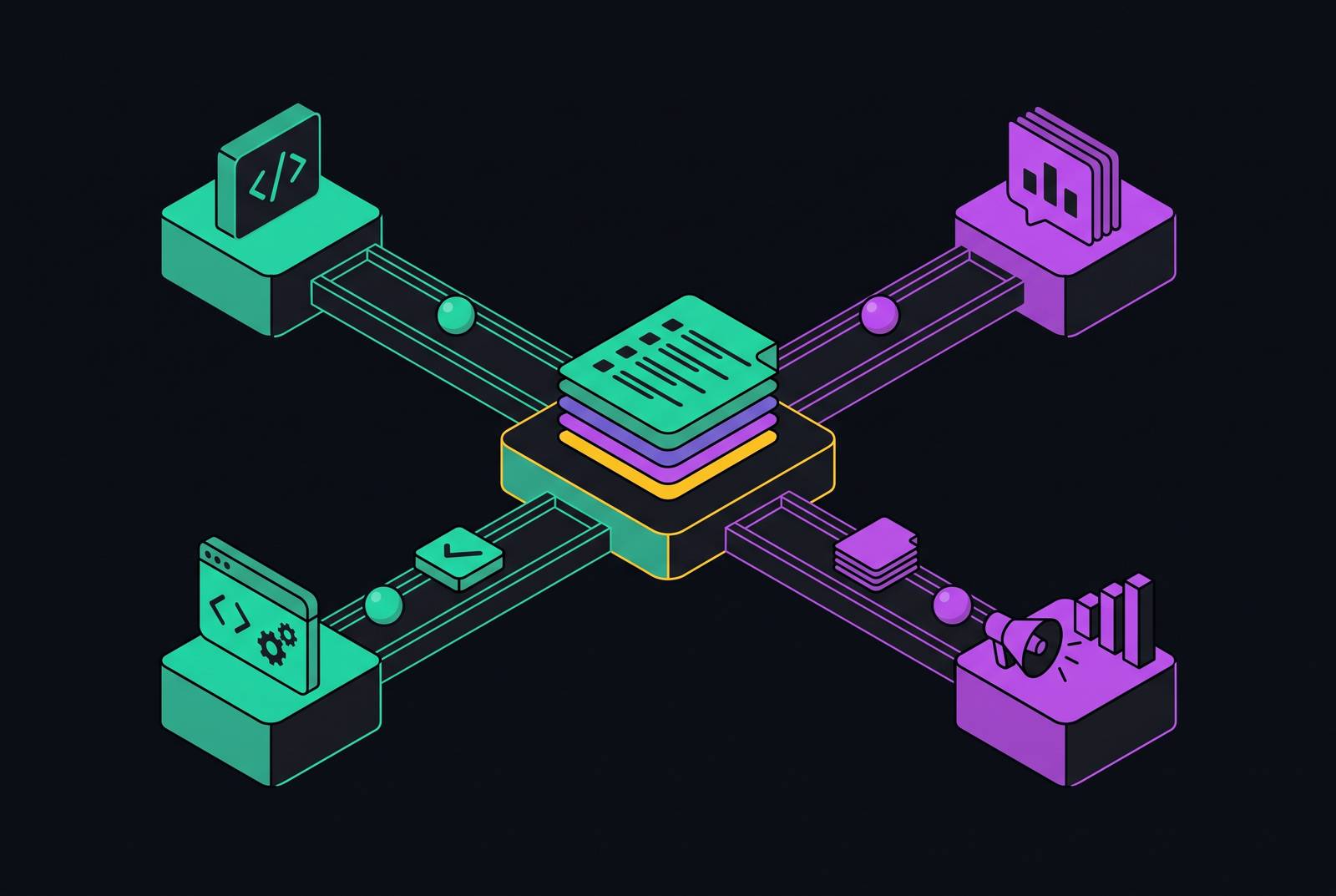
A changelog that works for both engineering and marketing is not a single document at all. It's three, derived from the same raw material, each written for a different reader. Call them Layer 1, the technical changelog; Layer 2, the public changelog; and Layer 3, the changelog newsletter. All three start from the same feat: and fix: commits moving through the repo, but each one reframes that source for a different job.
Layer 1 lives in CHANGELOG.md, inside the repository itself, following the keepachangelog.com standard: entries grouped by release and sorted into Added, Changed, Deprecated, Removed, Fixed, and Security. It's written for developers integrating with the API, contributors, and technical evaluators sizing up the product, and it ships every release, no exceptions.
Layer 2 lives at a public URL, something like yoursite.com/changelog: dated entries, screenshots, plain descriptions of what a user can now actually do. This layer serves existing users deciding to explore a new feature, prospects reading shipping velocity as a signal the product is alive, and search engines indexing long-tail traffic off of feature names. It runs on a tighter clock too, something like two to five entries a week.
Layer 3 is the weekly digest, usually a Friday email, that pulls the week's changes into three to seven bullets plus a short paragraph of commentary from someone who actually built the thing. It goes to users who opted in for product updates, and it runs weekly, full stop.
What holds the three layers together isn't shared prose, it's a shared source with three different framings. File paths are the language of Layer 1. Layer 2 talks in user actions. Layer 3 talks in user impact. That's the whole trick: not three teams arguing over one document, but one pipeline branching into three outputs, each tuned to what its reader actually came for.
This is also what resolves the engineering-marketing standoff, and it resolves it structurally rather than through negotiation. Engineering owns Layer 1 outright, no compromise on technical precision needed. Marketing owns Layer 2 and Layer 3, and neither one requires rewriting from memory. Everybody's writing from the same ground truth. Nobody's translating from scratch.
Layer 1: why commit quality is the upstream bottleneck for everything downstream
Everything downstream depends on what happens at the commit line. If commit messages are vague, terse, or inconsistent, there's no reliable signal for a human writer or an automated tool to work from when deciding what changed and how much it matters. Conventional Commits fixes this by standardizing the format: prefixes like feat: and fix:, footer tokens like BREAKING CHANGE:, all of it mapping directly onto Semantic Versioning, so the pipeline has enough signal to classify significance automatically.
Skipping that discipline leaves a team with two bad options: review every diff by hand, which falls apart the moment release cadence picks up, or publish nothing, which is what most teams quietly default to. The keepachangelog.com format, reverse-chronological, grouped by release, sorted into Added, Changed, Deprecated, Removed, Fixed, and Security, gives Layer 1 a structure that's durable enough for a human to read and clean enough for tooling to parse, and thousands of teams already run on it.
Not everything belongs in that record, either. The rule is simple even if applying it takes judgment: anything that changes user-observable behavior goes in. Internal refactors that don't touch behavior, dependency bumps, and tooling updates don't belong in the user-facing log. This is a filtering problem more than a writing problem. Every entry that doesn't meet the bar dilutes the ones that do, and a changelog padded with noise trains readers to stop reading it.
Once Layer 1 is solid, the raw material exists to build the other two layers. The question shifts from "what happened" to "how do I say this so a user who's never heard of PKCE flow understands why it matters to them."
Layer 2: translating technical changes into user-facing entries that people read
A commit that reads "refactor auth middleware to support PKCE flow" tells an engineer what happened. It tells a user nothing. What that user actually needs to know is that they can now log in through their identity provider. That gap, between what changed technically and what a person can now do differently, is the entire job of Layer 2, and closing it is what separates a changelog people read from one they scroll past.
The qualities that make that translation land aren't mysterious, and the pattern holds across the companies doing it well: clear categorization so a reader knows instantly whether they're looking at a new feature, an improvement, or a fix; benefit-focused headlines that describe what the user gains rather than what the team built; screenshots, GIFs, or short clips showing the change in motion; a cadence steady enough that users learn to check back; and distribution that pushes the update to people instead of waiting for them to stumble on it three clicks deep. Entries should stay short, one or two sentences, linking out to a doc or tutorial when a change needs more room rather than turning the changelog itself into a wall of text.
The clearest evidence for how this plays out in practice comes from the handful of companies that have actually built changelogs, and each one reflects a deliberate bet about who's reading. Linear runs a minimalist model: a timeline of short, punchy headlines prefixed by product area, Editor, GitHub, Issues, Agent, [API], each followed by two or three sentences and a link to documentation, shipping multiple times a week. It's the reference point for fast-moving developer tools where users expect to see progress constantly. Stripe runs the opposite instinct: monthly public API releases, major versions twice a year, date-based versioning, built for developers who need to track exact version compatibility against a live integration. Notion goes visual, blog-style entries with embedded video, a two-tier cadence of monthly major posts and weekly minor batches, giving big features full narrative treatment while small ones get a sentence and move on.
A few smaller examples round out the picture. Resend keeps a clean, minimal timeline of one-line entries, a headline, a sentence or two, and a screenshot, shipped weekly. Plausible Analytics reads like a developer talking to another developer, a plain reverse-chronological list linking out to GitHub for anyone who wants the technical detail, and that plainness is precisely why it works. Tailwind CSS goes the other direction entirely, full blog posts per release with code examples, migration snippets, and the reasoning behind design decisions, because a framework's audience needs the "why," not just the "what".
None of these formats is objectively better than another. The pattern that fits depends entirely on who's reading: minimalist for a fast-shipping developer tool, precision-focused for an API product, visual for something UI-heavy. Picking the wrong pattern for the audience is its own kind of failure, no less real than skipping the layer altogether. The canonical 2026 examples illustrate three distinct patterns a team can choose based on their audience (per S2, S8).
A well-written Layer 2 entry still fails if nobody sees it. A changelog page sitting at the bottom of a footer link, unindexed and unshared, is a well-crafted document with no readers, which is a distribution problem, not a writing problem. The sources identify five qualities that separate effective public changelogs from forgettable ones (per S2). Pure internal work (refactoring that does not alter behavior) stays out, anything that affects user experience in any way belongs in (per S5).
Layer 3: turning the public changelog into a distribution channel
Layer 3 doesn't require new material. It repackages what Layer 2 already produced and pushes it to people who were never going to visit the changelog page on their own. The format is tight by design: three to seven bullets covering what's visibly changed, plus one paragraph of commentary from whoever built it, sent weekly or on a Friday rhythm. One week's worth of commits ends up producing three separate artifacts this way, the CHANGELOG.md entry, the public page entry, and the newsletter bullet, with the framing shifting each time, from file paths to user actions to user impact. A workable version of this rhythm looks something like a founder sitting down Friday morning, reading through the week's drafts in one pass, adjusting the framing, and hitting publish, at which point the week's changelog entries become the newsletter without anyone drafting a second version from scratch.
Developers, specifically, are a strange email audience compared to the general marketing list, and require different treatment. They read changelog digests, technical guides, and documentation updates, and they delete anything that smells like a sales pitch or leans on buzzwords instead of specifics. Plain formatting beats polish here, with curated links, brief commentary, a technical deep-dive, a changelog summary, a plain white background, simple text, and inline links instead of a styled call-to-action button. The tone that earns attention writes like a peer, swapping "improved performance" for a number, a benchmark, a code snippet, something a reader can actually verify.
Distribution doesn't stop at email either. In-app widgets, social posts, and search indexing of the public changelog URL are all live channels, and locking that page behind a login wall quietly kills the SEO value and the prospect-trust value in one move. A GitHub releases page is better than silence, but it's still written for developers, not the broader audience a public changelog is supposed to reach, and a newsletter with no corresponding public archive means none of that content ever gets indexed at all. The baseline that makes every other channel possible is a changelog living at a real public URL, updated two to five times a week. And every entry, wherever it lands, should carry a clear next step, explore the feature, read the migration guide, try the integration, placed right next to the change it applies to.
At this point the three-layer model is complete, with one commit feeding a technical record, a public page, and a weekly push, each reframed for its reader. Volume, not design, is the next problem.
How scale breaks the manual version of this pipeline and what automation solves
The three-layer model holds up fine at low volume. A team shipping every few weeks can write Layer 1 by hand, translate it into Layer 2 over coffee, and paste the highlights into a newsletter on Friday. Higher release cadence makes the manual version of this buckle: releases stack up faster than anyone can translate them, entries get skipped under deadline pressure, and the public changelog quietly drifts out of sync with what the product actually does. That drift is worse than it sounds, because developer audiences treat changelog accuracy as a stand-in for product quality generally. A changelog that's wrong erodes more trust than a changelog that's simply late.
This is where automation earns its place, and what it actually automates deserves precision. Commit-based tools like conventional-changelog and release-please parse commit messages and spit out changelog text structured like the commits themselves, useful for Layer 1, but still built for a developer reading it, not a user. AI tools that read the actual code diff and generate user-facing language are solving a different problem entirely, the translation step, which is the same cognitive task a marketer does by hand, just running on every merged pull request instead of once a week.
The most detailed public example of this in practice comes from Matt Palmer's multi-agent changelog pipeline, published in December 2025, which strings together a workflow to draft, format, review, and open pull requests for weekly changelogs pulled straight from Slack updates, wiring together MCP servers, GitHub, and CI. What that setup demonstrates is that changelog content, treated like code, slots into the exact toolchain engineering teams already run, rather than living as a separate marketing task bolted on afterward.
The same logic extends outward past a team's own commits. Products that integrate with other platforms need to track what those platforms change too. That means watching documentation pages, changelogs, status pages, developer blogs, and OpenAPI spec files for breaking changes and new endpoints before a user runs into them unannounced. Tools built for exactly this, like Apify's API Docs Changelog Diff Monitor, compare documentation snapshots over time and flag what's been added, removed, or changed across endpoints, auth schemes, pricing language, and deprecation notices. Every one of those diffs is a potential migration guide or update notice waiting to be written, ideally before a user hits the breaking change cold.
None of this works, though, if the diffs just pile up unrouted. A signal nobody owns and nobody acts on is indistinguishable from noise. The severity filtering built into Layer 1, deciding what's user-observable and what isn't, matters even more once automation is generating candidate entries faster than any person could review them by hand. Automation still depends on the three-layer model. It's what keeps the model from collapsing once shipping speed outpaces what a person can translate alone. The output of this pipeline feeds all three layers, the same event produces the CHANGELOG.md entry, the public page entry, and the newsletter bullet without a human authoring each separately.
Sources
- Mastering Changelog Best Practices -With Real-Life Examples
- Developer Email Marketing That Gets Opened: Newsletters, Drips, and Product Updates | daily.dev Ads
- Changelog Marketing: The 2026 Pillar Guide
- 20 Changelog Examples Worth Copying in 2026 (+ Checklist) | Features.Vote
- 52 weeks of changelogs - Matt Palmer