Contributor Recognition Content That Retains Open Source Contributors
Recognition tied to shipping reinforces contributor retention better than annual thank-you posts.
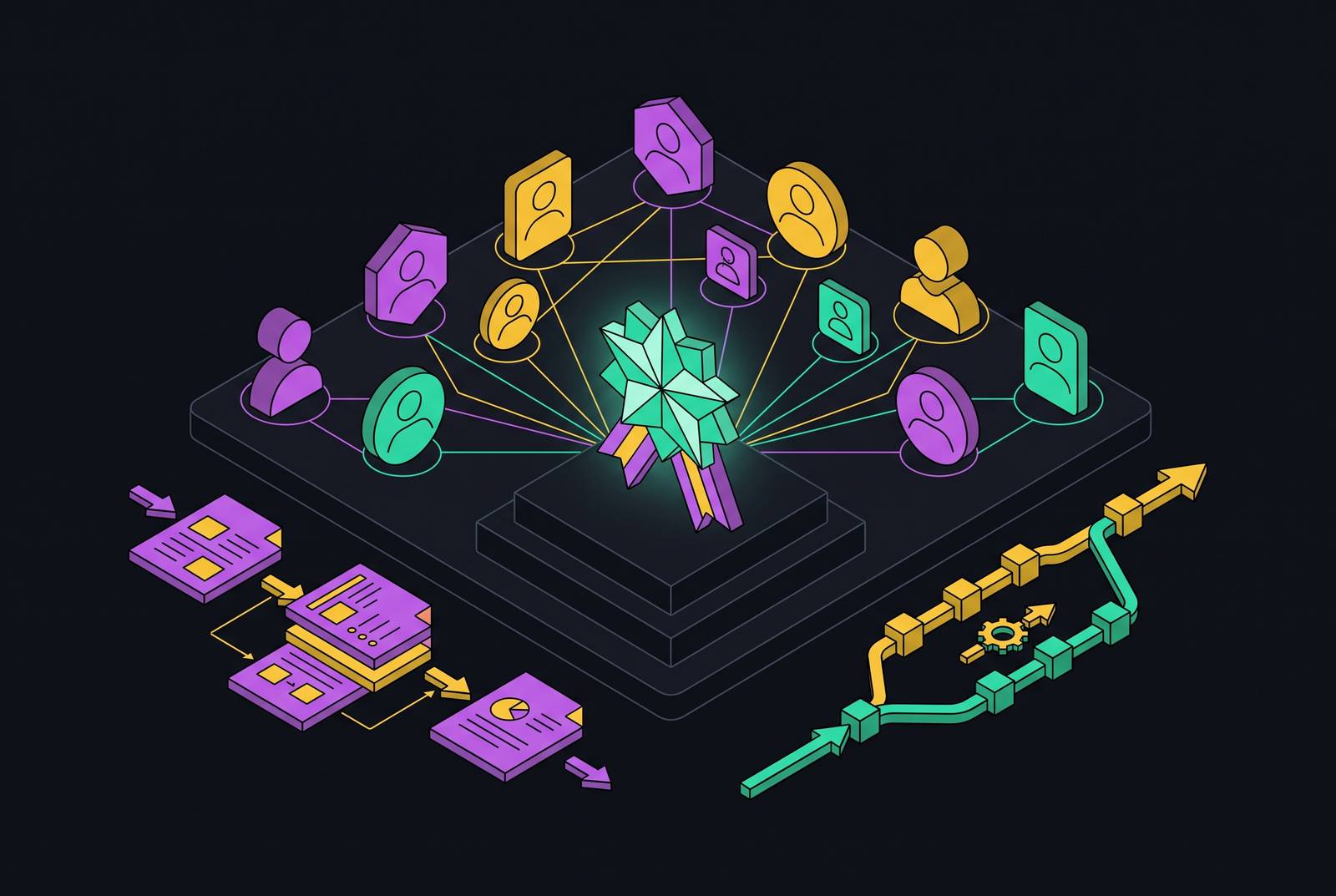
Content that recognizes open source contributors keeps them in the project when it is part of what the project publishes regularly. The effective form is tied to real contribution events, names the people responsible, and describes their work while it is still current. Generic appreciation cannot provide that connection. Recognition belongs in the workflow that records what shipped.
Why most open source contributors leave before they matter to a project
Abigail Cabunoc Mayes describes joining a campus club whose members were mostly in their third or fourth year. When most graduated the following year, they left a leadership gap, and she stepped up before she felt ready. There was an absence of people prepared to sustain the community. She sees the same pattern in open source, where less attention goes to bringing in newcomers and helping them become leaders than to maintainers who leave.
Most open source contributors leave after a single contribution. That makes the gap between participation and sustained responsibility a central problem for projects. Feng et al.’s Addressing OSS Community Managers’ Challenges in Contributor Retention, published in TOSEM, describes how turnover hinders progress and threatens sustainability as contributors take skills and institutional knowledge with them. A project can keep accepting pull requests while losing the people who could eventually maintain it. By the time that loss becomes visible, the opportunity to build continuity may already have passed.
What research shows about recognition and the early weeks that determine whether someone stays
Same Project, Different Start: How Contribution Events Shape Activity and Retention in Open Source compares event-based and organic contributors through a matched-cohort study across a large sample of projects. It finds that event-based contributors stay significantly longer and are more likely to become core contributors. The earliest weeks establish the pattern that predicts persistence. In the study, 68.9% of mentorship contributors sustain steady weekly activity through their early weeks, while organic contributors more often engage intermittently. Steady engagement predicts longer retention regardless of how someone entered the project.
Structured entry establishes a rhythm of recurring connection to the project that supports continued participation. Recognition tied to real contribution events can reinforce this rhythm by making individual effort visible as it happens. Feng et al. also identifies acknowledgment of contributors’ varied backgrounds and contributions as a support for collaboration and retention. These findings support recognition within an engagement structure, rather than proving that a thank-you post alone causes someone to stay.
The mentorship finding includes an important warning. Contributors who lose their program scaffolding show shorter retention than self-sustained contributors. A structure that works during entry therefore needs to persist or transition into something the project provides. Recognition content is useful in that transition only if it belongs to the project’s ordinary activity.
Why recognition content fails when it is ceremonial rather than event-driven
An annual thank-you post or a contributors page updated once a year separates acknowledgment from the work it recognizes. The delay weakens the connection between an individual’s effort and the project’s response. Generic wording compounds that distance by treating distinct contributions as interchangeable. The contributor receives appreciation without evidence of attention. That is a poor substitute for acknowledgment close enough to the event to reinforce continued participation.
Feng et al. finds that contributors leave for reasons that include burnout, lack of recognition, changes in their interests, and trouble fitting in. The study also describes retention dashboards and static snapshots as retrospective tools that reveal disengagement after it happens. Ceremonial recognition has a similar timing problem. It looks back when the publisher chooses to post, leaving it out of step with what the contributor is doing now. More polished prose does not repair that mismatch.
There is also a firm limit to content. Feng et al.’s survival analysis finds that volunteers stay for less time than employer-sponsored contributors, so recognition cannot make up for a gap in funding or incentives. Formal sponsorship, pay, and time set aside for the work do more to address that disadvantage. Recognition can support those arrangements by making contributions legible to employers, while reducing the effort contributors need to spend staying visible and connected.
What event-driven recognition content looks like in practice
A first-time contributor’s merged pull request gives the project a concrete reason to acknowledge their arrival. A milestone contribution gives it a reason to recognize sustained involvement. The event supplies the substance of the acknowledgment. Instead of praising dedication in general, the content describes what changed and attributes that work to the person who did it.
A release post can name contributors and quote someone on why they built a change, connecting the result to the reasoning behind it. A “Contributor of the Month” feature can share a contributor’s story and code snippets in release notes or a blog post. The distinction is not the label or format. Such a feature becomes useful recognition when the person’s actual work gives readers something precise to understand, rather than serving as a pretext for interchangeable praise.
The Mountain of Engagement framework extends this principle across a contributor’s development. A newcomer needs prompt, specific acknowledgment during the earliest weeks, while a core contributor needs visibility that employers and the broader ecosystem can understand. Recognition changes as the person’s investment grows. It is therefore a series of touchpoints.
How the changelog becomes the operational infrastructure for contributor recognition
The changelog already has the properties recognition content needs. It is tied to real changes, follows the project’s shipping rhythm, and reaches people who understand the work. Regular updates show that development is steady, and credits that name contributors show who worked together on it. No separate occasion needs to be manufactured. The release itself provides the reason to publish, and the contribution provides the reason to name someone.
Supabase’s engineer-as-marketer model brings the person who shipped a feature closer to the person who writes about it. The same principle applies to recognition, because the person closest to the work can describe it with the greatest credibility. The account of a change should preserve the knowledge of the people who made it.
A changelog entry can therefore do more than announce a product improvement. It can establish who contributed what and when, creating a visible, searchable record across releases. Each entry is small, but the archive accumulates. A website page or occasional contributor profile can draw attention to that record without becoming its only home. This is the changelog’s operational advantage over ceremony, because attribution travels with the work instead of waiting for a later editorial opportunity.
Why recognition content must be built into the publishing pipeline, not added to someone's to-do list
Recognition often depends on a maintainer who notices an event, decides whether to write about it, and then writes and publishes the content. Each step competes with reviewing pull requests, triaging issues, mentoring contributors, and coordinating releases. Under pressure, discretionary publishing is easy to defer. Adding another recurring responsibility to an overstretched team makes consistency depend on the spare capacity that the team already lacks.
The repository already contains the signals needed to remove some of that burden. Merged pull requests, first contributions, release tags, and spec changes can trigger a recognition workflow. The change becomes the brief. A first-time contributor’s merged pull request, a contributor’s tenth merged pull request, or a release with named credits each provides a discrete, attributable event. Automation that watches those events can start content when the work happens.
Selection is essential to that approach. Not every merged pull request warrants a separate post, and publishing indiscriminately would turn acknowledgment into spam. A scoring step can weigh changes against the project’s positioning and what the contributor has done before to choose which events to highlight. Drafting can then draw on the actual diff. The engineering problem is therefore not how to generate more sentences, but how to connect meaningful signals to a repeatable publishing path.
Why generic AI-generated recognition content is worse than silence
Generic AI-generated appreciation can undermine the relationship it is meant to support. Developers are right to distrust language that could describe anyone’s work, especially when it appears beneath their name. The supposed acknowledgment contains no evidence that the contribution was understood. Silence provides no recognition, but empty praise claims attention without demonstrating it. In that context, automation can make neglect look deliberate even when it results from limited time.
A named contributor alone does not solve this problem. Neither does attaching a pull request link to language about passion, dedication, or community. If the prose remains interchangeable, the event has become decoration. Faster production only scales the defect. A system that publishes generic thanks more consistently has optimized the wrong outcome.
Teams should set out three to five voice traits and their opposites so that it is clear when a draft breaks the guide’s rules. The model should get that guide, real examples, and the details of the contribution every time it drafts content. Voice constraints govern how the project speaks, while the diff supplies what it can truthfully say. Neither can substitute for the other.
Signal-driven recognition starts with attributable work. The standard is the same for human and automated writing. A reader should be able to tell why this contributor is being recognized at this moment. If that answer disappears when the name is removed, the content is still generic.
How to build a recognition publishing rhythm a lean team can sustain
For a lean team, the practical starting point is to define contribution events that warrant recognition before they occur. Those can include a first contribution, a milestone contribution count, named credit in a release, or a particularly complex merged pull request. The policy makes the selection once, rather than reopening the decision under pressure each time. Automation can apply it where available. Teams without full automation can use the same policy to guide recognition in the release workflow they already have.
The operational minimum is one recurring artifact the project can sustain without additional headcount. That might be a changelog entry with named credits, a monthly digest describing who contributed what, or a release post that quotes a contributor’s reason for building a change. The format is secondary to reliable attribution. Release notes, a blog post, and a website page are places to share the content, but each extra place adds work. A dependable record on one surface is more useful than an ambitious schedule that repeatedly slips.
Timing should also reflect the contributor’s stage. A monthly artifact does not replace a prompt, specific response to a newcomer’s pull request, because the earliest weeks are when engagement patterns form. Pipelines that watch merged pull requests can prompt that response without a maintainer having to remember. For a core contributor, the recurring public record can provide the broader visibility that sustained work deserves. The Mountain of Engagement framework connects these different needs without forcing them into one format.
The resulting mental model is straightforward. Recognition content is the engineering project’s own record of itself, made visible to the people who built it.