Publishing a Project Roadmap That Manages Community Expectations
Clear language matched to your confidence prevents community trust from shattering later.
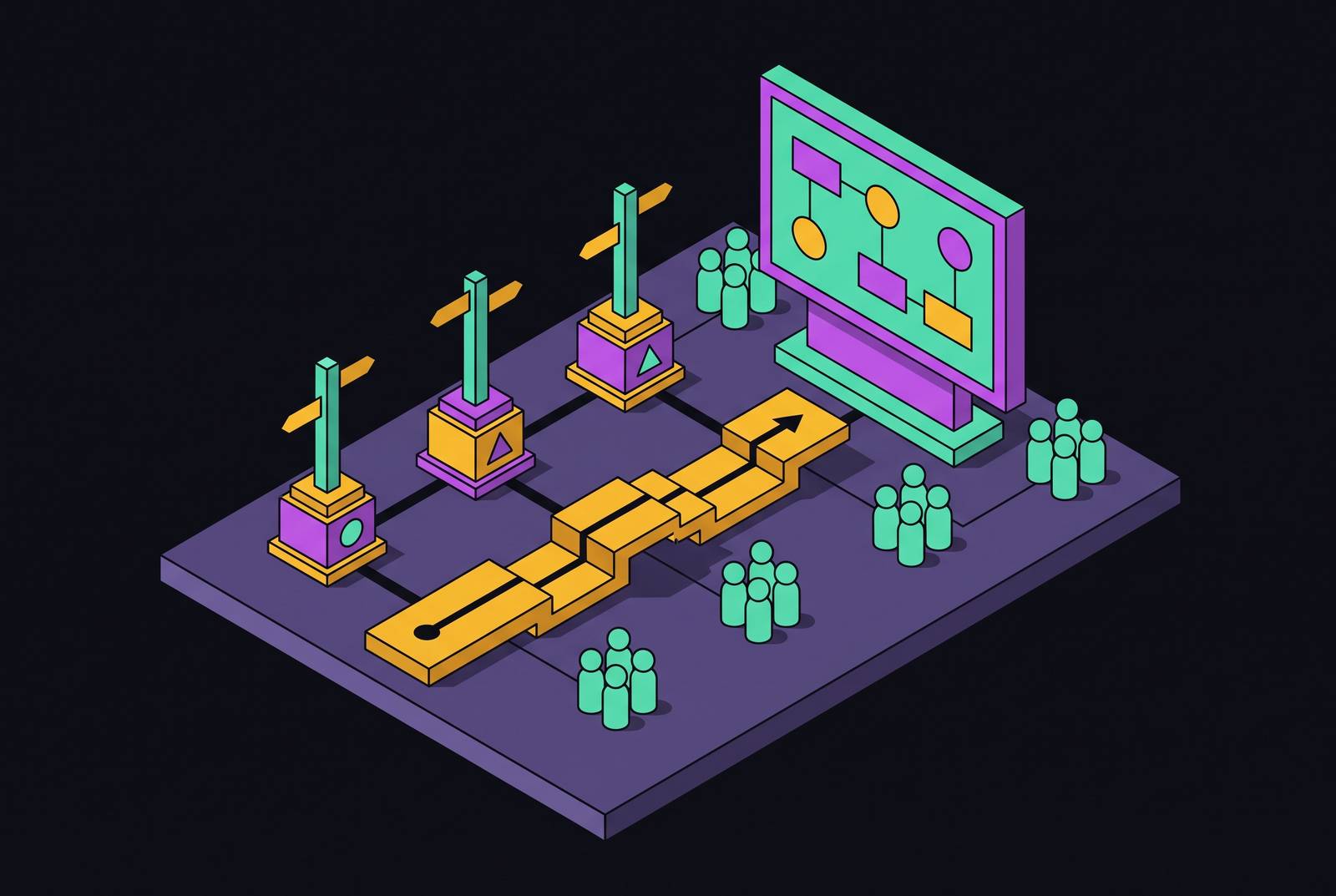
Publishing a project roadmap is an exercise in managing community expectations. Its primary job is to keep what people believe will ship aligned with what the team can deliver. Treating the roadmap as a trust instrument changes how commitments are scoped, how delivery is documented, and how quickly uncertainty must become public.
Why a roadmap's primary job is managing the expectation gap, not communicating a plan
A public roadmap gives the community a basis for decisions before the work is complete. Its descriptions and dates tell the community what to expect, even after the team's internal plans change. The team must keep those expectations calibrated as its confidence, priorities, and delivery prospects change.
That obligation is easy to overlook when the roadmap is treated as a marketing asset. Ambitious features and firm timelines can get people excited, but readers can point to the same document when the team falls short. The promise remains visible after its assumptions have expired. Format, cadence, and wording are therefore trust-calibration decisions. Once the roadmap is understood this way, scoping commitments becomes its first design problem.
How the specificity of a commitment determines how much trust it can lose
Specificity determines both the strength of a promise and how precisely the community can measure a miss. Directional language about exploring an area offers a weak commitment, so a change of direction puts relatively little trust at risk. Naming a feature creates a more definite expectation. Without a date, its absence is observable, but the community has no agreed point at which delivery becomes late. Adding a quarter or milestone makes the miss both observable and timestamped, while an exact date makes it public and immediate.
LibreChat illustrates how a roadmap can establish the record against which delivery is judged. Its Admin Panel appeared as a Q1 focus from 2025 and became available for testing in early April 2026. The maintainer explained that the v0 iteration was ready but awaited a security review before being made public. That explanation identified a reason for the final delay. It did not erase the earlier expectation recorded on the roadmap, which gave the community a basis for measuring the gap.
Commitments should use clear language with specificity matched to confidence. Items already in active development can have quarter-level dates, while work still being scoped should remain directional. The document needs a place to say what is still uncertain. OpenProject's 2025 roadmap provided one by saying that sharing openly invited the community to see where the software was heading while acknowledging that “plans may evolve.”
Why "shipped" indicators on past items are the mechanism that makes future commitments credible
Even promises with a clear scope need evidence behind them. A dated “shipped” indicator supplies that evidence by connecting an earlier commitment to a completed result. It is more than administrative housekeeping. A community that can see consistent delivery has grounds to read a missed item as an exception, whereas a roadmap with no delivery history offers little basis for that interpretation. Past completion gives future commitments a context.
Lynx's 2026 roadmap demonstrates this relationship at the level of release cadence. After a year of bi-monthly releases, Lynx published a monthly schedule that named each version from version 3.8 through version 4.5. Readers could assess the new schedule against an established rhythm rather than treating it as a promise made without precedent. The historical record made the change in cadence intelligible.
Linear, Vercel, and Resend likewise treat dated “shipped” indicators as a primary credibility asset. That asset has a condition attached. A slip still needs a quick explanation, because what the team shipped before cannot tell readers where an overdue item stands. The record establishes that the team can deliver, while the explanation accounts for why this item has not. Without that explanation, the community is left to supply its own account.
Why silence is the most damaging thing a team can publish on a roadmap
Silence after a missed commitment is not neutral. When an item has no update, explanation, or “shipped” marker, readers can interpret the gap as abandonment, a struggling team, or a promise that was never serious. The stale entry itself becomes a signal because the community still has the original commitment but no account of what changed.
LibreChat's Admin Panel shows why the communication gap is distinct from the delivery delay. The item went quiet for months before the maintainer surfaced in April 2026 to explain that the v0 iteration was ready and awaiting a security review. By then, silence had left the earlier expectation unresolved. A legitimate reason for waiting cannot retrospectively provide the updates that were missing.
For teams that regard withholding an update as the safe choice, this reverses the risk calculation. Not publishing avoids a new statement, but leaves an old statement uncorrected. Teams can correct this through deliberate update hygiene. A brief entry explaining that work remains in progress and identifying the reason for delay can preserve more trust than a polished announcement six weeks later.
How treating the changelog as a continuous trust signal changes the update cadence problem
The operational alternative to silence is a changelog that runs as part of delivery. Here, teams publish when the product changes and use larger announcements for a separate purpose. Supabase makes that separation concrete. Its continuous changelog and GitHub releases for all packages keep the record up to date, while Launch Week events roughly every 3–4 months bring updates together around themes.
That distinction connects the roadmap to the changelog. The roadmap entry states the commitment, and the changelog entry supplies the delivery receipt. Treating them as unrelated publishing events makes it easier for an item to ship without its public status being resolved. Treating them as one trust story ties the update cadence to changes in the underlying state.
The same source material can feed three layers of communication: a technical changelog that cites file paths, a public changelog that describes user actions, and a newsletter that explains the impact on users. Each layer translates the change for a different reader. Resend's developer-focused entries use code snippets, “New / Fix / Improvement” tags, and links to API references to help developers understand the product.
Why audience segmentation determines what "the right level of detail" actually means on a roadmap
The three-layer model exposes why there is no universally correct level of roadmap detail. Engineers seek implementation signal, business stakeholders seek stability signal, and contributors seek prioritization signal. Their questions are different. A technically precise entry may still fail as communication if it answers none of the questions its reader needs to resolve. Detail is useful only in relation to the decision it supports.
An entry about migrating the auth layer to a new provider illustrates the difference. An engineer deciding whether to build on that layer can extract a relevant implementation signal from it. A founder evaluating the product receives much less useful information. The wording says what will change in the technology but may leave readers unsure of what that means for stability. Adding more implementation detail would deepen the engineer's understanding without resolving the founder's uncertainty.
The resolution is not to maintain two roadmaps, but to let readers reach different depths from a readable public entry. PostHog links features to GitHub issues and community discussions so engineers can look into the work behind them without every reader having to do so. The surface and the supporting detail serve different purposes. Developers also learn about roadmaps more and more through AI assistants and research tools, as well as by reading them directly. That makes clear public wording useful beyond the immediate page, but it does not change the central task of identifying whose expectations an entry must calibrate.
How automated signal monitoring changes when and how roadmap updates get published
Maintaining this communication structure is expensive for lean teams. Continuous changelog entries, prompt explanations, and audience-appropriate detail all require attention that competes with delivery work. The resulting gap is often about bandwidth. A team can understand what its roadmap ought to say and still lack a reliable way to extract the relevant changes and turn them into drafts. Automation addresses that constraint by moving the starting point from a blank page to captured signals.
Running on the Claude API, it produced 52 consecutive weekly changelogs from Slack threads and internal context. The AI drafted the full changelog end-to-end. A human reviewed and merged the resulting pull request rather than performing a substantive editorial pass on story, tone, or the removal of internal content. The human nevertheless retained authority over what was published.
Commits feed a changelog generator, the generator drafts the technical layer, a human editor turns that material into a public post and newsletter, and automation handles distribution. Signal monitoring brings the same approach to keeping the roadmap up to date. Merged pull requests, releases, and API spec changes can trigger update drafts, cutting the time between a change in the product and a draft that explains it to the public. The trigger supplies a reason to review the roadmap while leaving publication subject to editorial judgment.
That distinction sets the boundary for automation. In Palmer's workflow, the AI drafted for the human editor, who held editorial authority over story and tone. An automated draft does not decide what the community needs to hear. A release signal may also leave unexplained why a separate commitment has slipped. Monitoring can reduce extraction work and surface occasions for updates, while the team remains responsible for interpreting those signals and explaining their consequences.
What a team that treats the roadmap as a trust instrument actually does differently
At the commitment layer, the practical recommendation is to reserve named features with quarter-level dates for work already in active development. Items still being scoped remain directional, while community requests sit in explicit “considering / not committed” categories. These distinctions make the promise boundary visible. Readers can separate an acknowledged request from planned work without having to infer commitment from its mere presence on the page.
At the update layer, the recommended structure is a rolling three-month view updated monthly, with clear “shipped” indicators and a cadence tied to shipping. Prompt explanations of slips supplement that rhythm. A monthly review is not a reason to leave a known delay unexplained until the next scheduled refresh. The delivery record needs to match where the work stands now, even if the update is short and the work is still unfinished.
At the audience layer, engineer-readable changelog entries, a user-readable public roadmap, and a stakeholder-readable newsletter provide different depths from the same source material. The roadmap's job is not to look confident, but to keep the community's expectations calibrated to reality, and every structural choice either serves that function or undermines it.