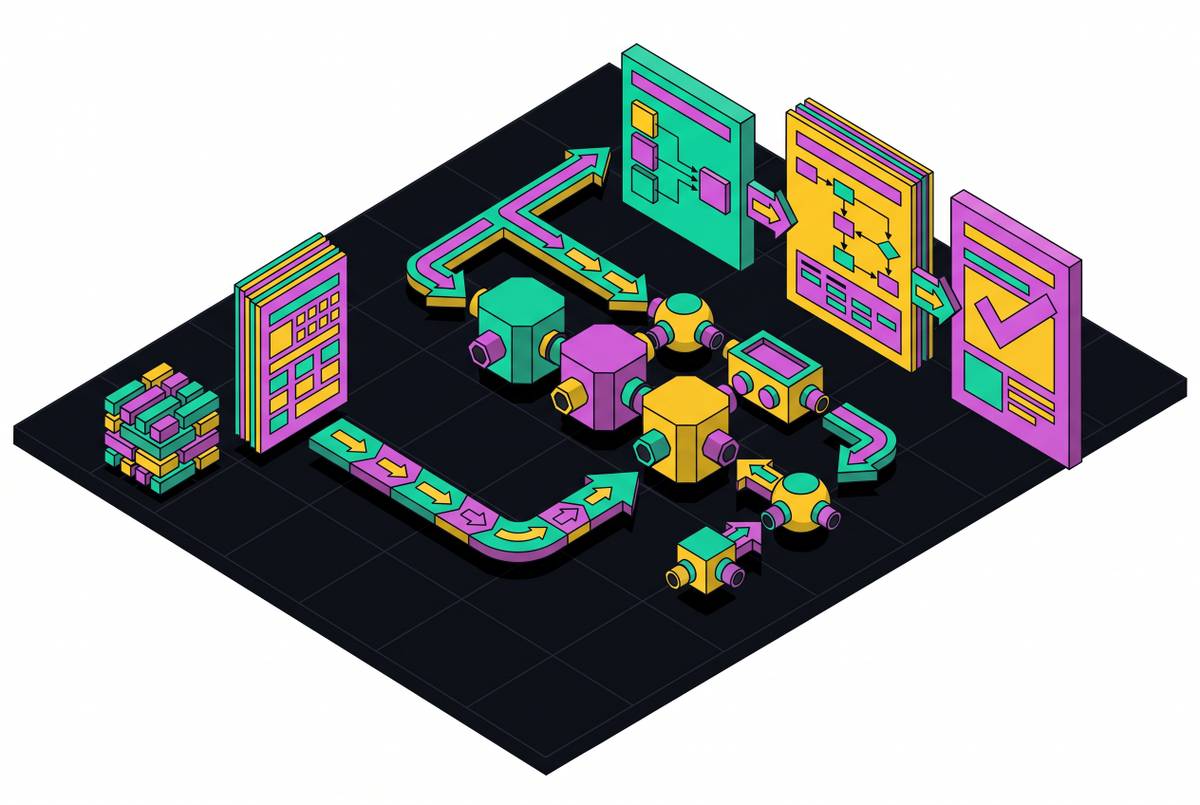
Scoring Pull Requests for Content Opportunity
A framework for identifying which code changes deserve marketing coverage.

A typical engineering team merges hundreds of pull requests a month. Almost none of them become a blog post, a changelog entry, or a release note. GitHub Octoverse 2025 recorded 518.7 million pull requests merged in public repositories in a single year, a stream of shipped work that almost no marketing team is reading as content. Most of that stream is noise: dependency bumps, formatting passes, CI config tweaks, and typo fixes sit in the same queue as the changes that would genuinely interest a technical audience. Without a way to tell the two apart, teams either ignore the queue altogether or publish on a schedule that has nothing to do with what engineering actually shipped that week.
What a pull request description signals about content potential
Before any scoring framework gets applied, the pull request description itself is already doing a version of that work, provided the author wrote it well. A mixed-methods study of 80,000 GitHub pull requests, presented at the International Conference on Mining Software Repositories in Rio de Janeiro on April 13 to 14, 2026, found that developers value descriptions highly, but not for uniform reasons: purpose and code explanation preserve rationale and history, while stating the desired feedback type best predicts whether a change gets accepted and how much reviewer engagement it draws. For content purposes, the useful split is between PRs that explain why a change was made and PRs that only describe what changed in the code. A PR that names the user-facing motivation, the problem it solves, is a natural candidate for a post; one that only lists code changes isn't.
That distinction has a direct operational cost. A PR with an empty or purely technical description forces a content writer to reconstruct the story from scratch, interviewing the engineer, digging through the diff, guessing at the motivation. A PR with a clear purpose statement hands the content team something close to a first draft of the angle, already written by the person who understood the change best. That gives teams a cheap filter to apply before any scoring logic runs: if the description can answer "what changes for the user or the developer integrating this?", it clears the bar to be scored. If it can't, scoring it is premature, and the right move is to fix the description or set the PR aside.
The four axes a scoring framework should weight
Content-worthiness breaks down into the sum of four distinct signals, each one assessable on its own and at scale. This mirrors an idea already familiar in engineering metrics, where a deeper cause produces the visible pattern: tools that measure code changes increasingly discount renamed files, copied code, and formatting noise because that noise obscures the genuine work in a diff, and stripping it out is what surfaces that work. Content scoring needs the same discipline, separating real signal from the motion of merging code.
The first axis is user-facing impact. Does the change affect something a user or integrator will notice? New capabilities, changed behavior, removed friction, and breaking changes score high; internal refactors, test additions, and linting fixes score low or at zero. Metrics tools in 2026 increasingly separate workflow metrics (how fast did it merge?) from value metrics (how meaningful was the code change?), and that same axis split applies when scoring for content.
The second axis is positioning relevance. Does the change reinforce something the company claims to be true about its product? A feature that demonstrates a core differentiator scores higher than one that simply matches a competitor's existing capability. Raw PR metrics are useless here: commit frequency, PR volume, and cycle time say nothing about whether a change matters to the company's story. Scoring positioning requires writing down the company's actual claims in plain language, not marketing copy, and turning them into a rubric that can be checked against each PR's description and diff.
The third axis is audience signal. Is there evidence the target audience already cares about the problem this PR solves? Open issues or discussions the PR closes, community upvotes on a feature request, stars or forks on a related project, and inbound questions in support channels all count. GitHub's API surfaces exactly these behavioral signals, stars, forks, issues opened, and they correlate with developer intent the same way they predict trial conversion; with 395 million public repositories on GitHub as of Octoverse 2025, the pool of available signal is large. A PR that closes a widely-upvoted issue has an audience that has already voted to read about it. A PR that adds an internal optimization no one discussed in public has no built-in readership waiting.
The fourth axis is novelty and differentiation. Is this the first time the product has done something, or a real step beyond what it could do before? First-of-kind changes score highest; iterative improvements score lower unless they close a gap users have been asking about for a long time. Breaking changes and API changes deserve special handling here: they can score high on urgency, because existing users need to know, even when they score low on novelty, and they often belong in a different format, a release note or migration guide, rather than an announcement post.
Weighting and combining the axes into a usable score
Four axes only matter if they produce a decision at the end: publish now, publish later, or skip, each with a rationale a team can revisit and refine. The weights assigned to each axis should reflect current priorities rather than some fixed, universal ratio. A team launching a new API integration should weight positioning relevance higher than a team in the middle of a major performance pass. A simple three-tier output handles most cases: scores above a set threshold trigger a content workflow right away, mid-range scores go into a weekly review queue, and scores below the floor get logged and skipped.
Consider a hypothetical PR: a team ships a new bulk-export feature for a data platform. Scored against the four axes, it might land high on user-facing impact (users directly interact with the new export button), high on positioning relevance (the company has been telling prospects that data portability is a core value), moderate on audience signal (two open feature requests ask for this, but neither is heavily upvoted), and moderate on novelty (competitors already offer bulk export, though this implementation adds filtering they don't). Combined, that profile likely clears the threshold for a blog post, because three of the four axes land solidly in range. One PR, four scores, one decision.
A natural objection follows: won't a framework like this flag more "high" scores than a lean team can realistically produce content for? Threshold calibration answers it. If the top tier is generating more work than the team can handle, raise the bar, or add a fifth filter, such as whether a usable draft already exists in the PR description. The rubric itself isn't static either: it should be versioned and reviewed every quarter, because what counted as novel six months ago may be table stakes now, and the weights need to shift to match. None of this depends on a particular tool. A spreadsheet, a Notion database, or a GitHub Action reading PR labels and descriptions can all run the same logic; what matters is applying it consistently, not which mechanism holds it.
Routing a scored PR's output: changelog versus blog post versus release note
A high score doesn't automatically mean a blog post. Getting the format wrong wastes the value of the score itself: a breaking change buried inside a long-form article misses the urgency that users need, and a minor UX tweak inflated into an announcement post reads as padding to a developer audience. The format decision rests on a basic distinction: release notes explain changes in language aimed at users, while changelogs keep a technical record of every code modification, and scoring has to account for which audience a given PR is actually speaking to.
Routing logic can follow the score and the type of change directly. A high score paired with a genuinely new, user-facing capability points to a blog post or announcement, with a changelog entry generated alongside it as a secondary record. A high score paired with a breaking change or a deprecation points to a release note first, a migration guide if the affected API surface is large, and a blog post only if the team judges it warranted. A mid-range score, especially one where several related changes are accumulating, is often best bundled into a single changelog entry, with the option to promote the bundle to a blog post once enough related changes stack up. A low score usually belongs in the changelog alone, or gets skipped entirely if the change is purely internal.
The changelog is the most underused layer in this whole structure. It captures changes that don't rise to the level of a blog post but are too relevant to users to bury inside a GitHub releases page written for developers. Companies like Linear, Vercel, and Resend are cited in 2026 as examples of changelogs run well as public, user-facing pages rather than developer-only logs, and that public framing compounds both SEO value and trust with prospects over time. That compounding effect depends on where the content lives: a changelog locked behind a login loses both the SEO benefit and the trust it would otherwise build with people evaluating the product.
Josh Miller set a precedent for format ambition, turning release notes into episodic video updates that users genuinely looked forward to, though Arc was frozen in May 2025 as the company shifted its focus to the AI browser Dia, so the example belongs in the history of format experimentation rather than as a current playbook. On the retention side, Featurebase shows what closing the loop looks like in practice: linking feedback posts to changelog entries so that everyone who voted for a feature gets notified automatically when it ships, with Senja.io cited as a customer example of the pattern in use. That turns a routed piece of content into something that drives retention and word-of-mouth on its own.
Automating the scoring pipeline from repo signal to content queue
A scoring framework only compounds in value if it runs on every merge, not just the ones a person happens to notice, and that means the pipeline needs to be built into the repo's infrastructure rather than left to someone's judgment. The GitHub API is the natural entry point: webhook events fire the moment a pull request merges, carrying its title, description, labels, and commit SHAs. Linked issues and diff metadata need separate API calls to retrieve, but what arrives by default is already enough structured data to run the four-axis rubric automatically. This is the same architecture already used to connect GitHub webhook events to CRM records and attribution models in real time: a webhook fires, a scoring function runs, and the result lands in a content queue carrying a score, a rationale, and a suggested format.
Labels make this dramatically more reliable. A team that adopts a consistent convention, tags like breaking, user-facing, internal, and api-change, gives the scoring function clean inputs to work from instead of forcing it to infer everything from free text.
Two modes emerge once the pipeline is running. In a review-gated setup, the pipeline scores and queues candidates, and a human still approves the headline and the format before anything goes out. In a fully automated setup, PRs that score above a set confidence threshold route straight to a drafted and published output with no manual step in between. Which mode a team runs depends on its tolerance for risk and how mature its scoring rubric has become; neither mode is more "correct" than the other, and a team early in building its rubric has good reason to stay review-gated until the scores prove themselves reliable.
Teams that hand a model a blank prompt get output that requires heavy editing, misses brand voice, and sometimes contains claims nobody actually approved. Glean's 2025 research on AI content at scale documents this as the primary way these efforts fail. The skeptical case goes further still: using a commercial AI tool, there's no way to actually train it to sound like a given company. All a team can do is add material to its local memory and hope the model draws on it consistently, and that limitation is real for any general-purpose tool used without grounding.
Automation shouldn't be abandoned; it should be grounded, because AI content built on a real event with structured inputs starts from a different place than a blank prompt, with a PR-grounded draft starting from that footing entirely. It begins with a named, real change, a description the author wrote at the time, a set of linked issues, and a score with a documented rationale behind it, all of it built before a single word of a draft gets generated. Grounding of that kind doesn't eliminate editorial judgment. It gives editorial judgment something concrete to check the draft against: did the AI accurately represent what the PR actually did, does the claimed positioning match the rubric the team wrote down, does the urgency match the breaking-change label attached to the pull request. Teams that build the scoring and routing logic described here keep a human in the loop. They're giving the human a structured, auditable decision to review instead of a blank page to fill, which turns automation from a risk into an advantage.