Async Content Review Processes for Distributed Engineering Teams
Async review disciplines cut publishing delays in half by treating content like code.
A changelog entry, a release blog post, an API diff that needs a marketing explainer: each of these stalls when review is treated as a meeting-required handoff across time zones. Distributed engineering teams solved this problem in code review years ago. The same round-trip cost that was killing PR velocity is now killing the gap between ship and publish.
The arithmetic is identical. A developer in one time zone merges a feature on Tuesday afternoon. The author wakes up Thursday, answers one, asks a clarifying question on another. The content equivalent runs the same course, only slower, because the artifact never had to exist in the first place. Features ship continuously. Published stories about those features accumulate in draft, waiting for someone to open a calendar slot.
Content teams have not internalized what their engineering colleagues learned a decade ago. They still treat review as a synchronous gate: a meeting, a Slack thread, an open-ended back-and-forth that could have been a decision. The fix is not better tooling. It is a set of disciplines that minimize the number of exchanges needed to reach an outcome, and those disciplines transfer directly from code review to content review because the cost structure is identical. A comment that needs a clarifying question before the author can act is, across time zones, a two-day comment, whether it sits on a diff or a draft.
What async code review actually optimizes for — and why it transfers
The reason async code review works for distributed engineering teams is not the platform. It is a set of disciplines that reduce exchange count, and exchange count is the metric worth optimizing because it is what the process controls. Geography fixes latency. But every exchange added to a review, every clarifying question, every dribbled comment, every ambiguous state between revisions, multiplies that fixed latency into days. Teams that adopt the right habits routinely drop a full round trip per PR.
The first discipline is front-loading context. The author does the orientation work before requesting review, so the first pass needs no clarifying questions. This means annotating the diff, flagging the risky part, explaining the approach that was rejected and why. The reviewer starts with a decision to make, not an investigation to run.
The second is batched feedback. Commenting as you read is an office habit, carried over from the era when the reviewer sat next to the author. Async, each dribbled comment is potentially its own day-long round trip. The discipline is to read the entire artifact, then submit one review that states an explicit outcome and separates blocking issues from suggestions. Every comment carries enough context to be actionable without a follow-up.
The third is the explicit handoff note. Whoever touches the work last writes one summary: what was addressed, what is still open, whose move it is. The counterpart starts their day with a decision to make rather than an investigation to run. This kills the silent killer of distributed work, which is ambiguous state.
The fourth is reserving overlap hours for threads that genuinely need back-and-forth. A design dispute that has gone two rounds in comments will not converge on a third. The discipline is to pull it into the next sync window, resolve it out loud, and summarize the outcome back onto the record. Everything else stays async, where it belongs.
All four disciplines transfer to content review because they are format-agnostic. They optimize the number of exchanges, not the speed of any single response. A clarifying question that blocks an API explainer costs the same two days as one that blocks a code change.
Mapping the four principles onto a content review workflow
Naming the mapping explicitly is what lets a team change their workflow instead of agreeing with an idea. Each code-review discipline has a content-review equivalent, and the transfer is one-to-one. Front-loaded context becomes the author's brief traveling with the draft. In code review, the author annotates the diff before requesting review. In content review, the equivalent is a short header attached to every draft: what signal triggered this post, who the intended reader is, what the one claim is, and what the reviewer is being asked to decide. Without this, the first review pass is orientation, the reviewer reconstructing the author's intent, and across time zones that orientation costs a day.
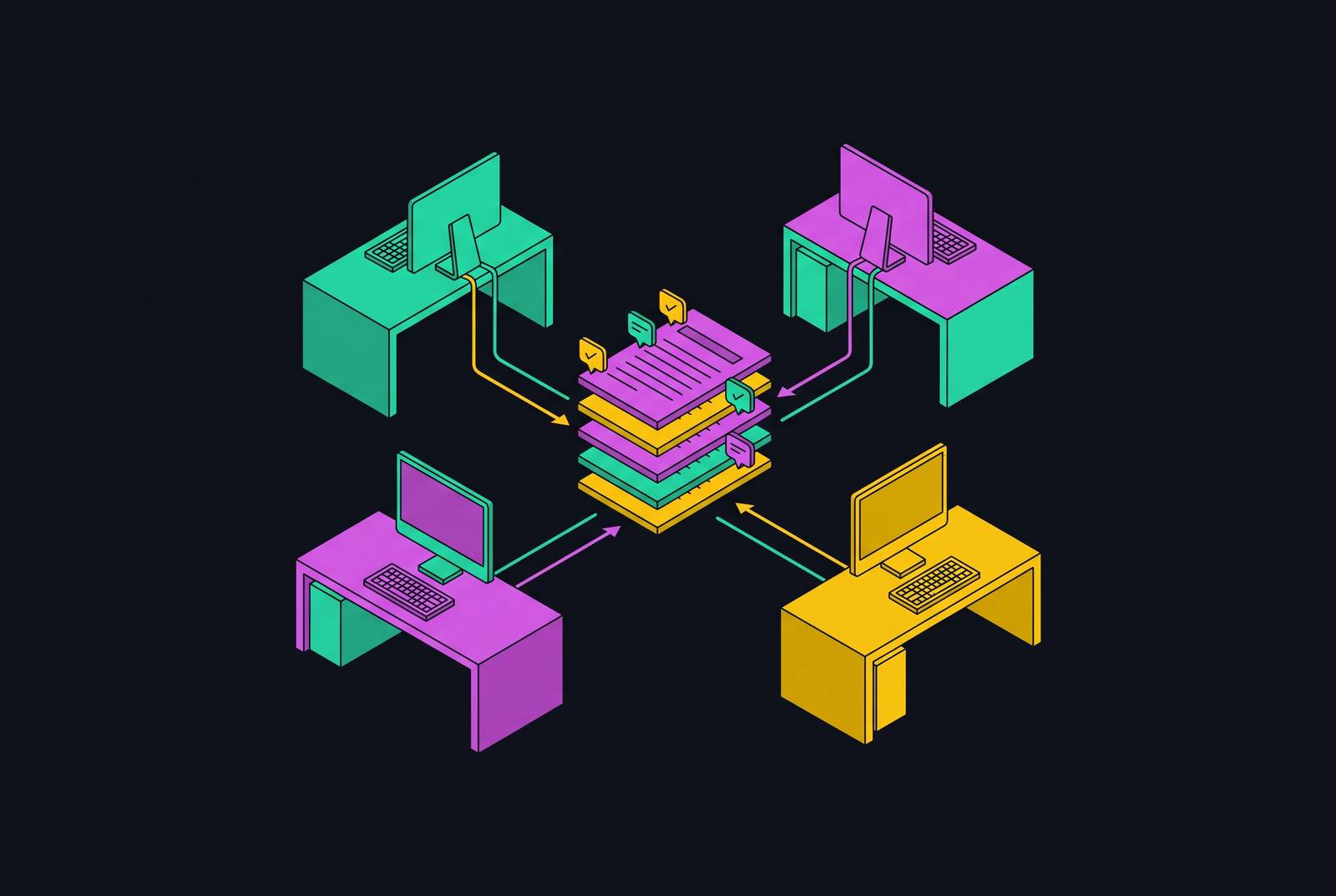
Batched feedback becomes one complete review pass with an explicit verdict. Reviewers who comment as they read a draft produce the content equivalent of dribbled PR comments, and each reaction is a potential separate round trip. The rule transfers directly: read the entire draft, then submit one review that states approve, approve with minor edits, or changes needed, separates blocking issues from suggestions, and asks every question in the same pass. Each comment should carry enough context to be actionable without a follow-up, the equivalent of a code-review comment that explains the why, not just the what.
The handoff note becomes explicit state on every draft before it goes dormant. The author revised but did not say which feedback they addressed. The reviewer glanced again but did not say whether they are done. The fix is a norm: whoever last touches a draft before stepping away writes one summary comment that lists what was addressed, what still needs a decision, and whose move it is. It is a thirty-second habit that eliminates the day lost to investigation when the counterpart logs on.
The sync reservation becomes a two-round cap on async disagreement. Any content thread still open after two async exchanges, a disputed framing, a claim one party thinks is inaccurate, gets pulled into the next overlap window, resolved quickly, and summarized back onto the draft for the record. Everything else stays async: word choices, structural nits, factual checks with clear answers. The discipline is not about saving time in any single exchange. It is about not letting a fixable disagreement generate a week of increasingly formal messages.
Where content review has a problem code review does not: the signal-to-draft gap
Async review principles solve the review step, but distributed engineering teams lose most of their publishing velocity earlier, in the gap between a shipped change and a draft that exists to review. In code review, the artifact is created manually by the developer after pushing code, a separate step that the developer knows to perform. In content, someone has to notice that a release happened and decide to write about it. That decision step is where most stories die.
Engineering-led teams ship continuously. Their editorial bandwidth does not scale with their shipping cadence, so the backlog of undocumented changes grows faster than any human content process can drain it. The changelog is the content atom from which all other distribution should cascade: a merged PR, a spec change, a deprecation notice. But most teams collapse changelog and release notes into a single format that serves neither the technical audience nor the customer-facing one well. The technical reader wants the merged PR and its implications. The customer wants what changed and what to do about it. One document cannot do both jobs, and the attempt leaves both audiences underserved.
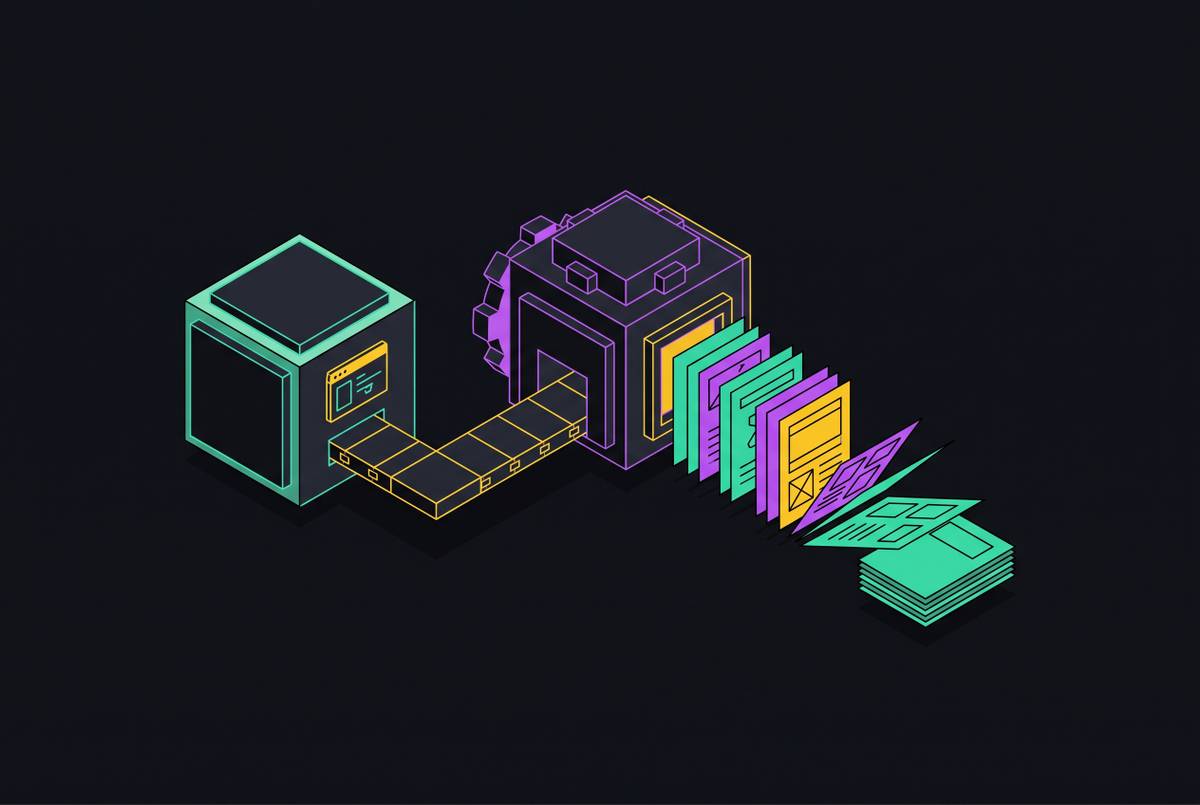
Signal-driven publishing closes this gap upstream of review. A draft triggers the moment a meaningful change lands, scored against the team's positioning to filter noise, so the async review workflow has something to work on. For API-first teams, the signals are machine-readable. A spec diff, a breaking change, a new SDK release can each trigger a draft automatically, the same way a merged PR triggers a CI run. The pipeline stops being a human noticing things around their existing responsibilities and becomes a system that catches every meaningful change as it happens.
Why the draft's origin determines how much review work is left
A draft that starts from a real event arrives at review with its claim already established, which compresses the review to execution decisions rather than strategic ones. A merged PR, an API spec change, a regulatory update: each of these is a brief in itself. The claim is not invented. It is observed.
When the draft's origin is a specific signal, the reviewer's job shifts from "does this have a reason to exist" to "does this say what the signal actually showed." That is a narrower, faster question to answer async, and it is the difference between a review that takes a day and one that takes twenty minutes. The principle is that the change is the brief. Content grounded in a real event is sharper than content started from a prompt because the claim came from something that happened, not from a guess about what might sound right.
The generic AI content problem sits on the other end of this spectrum. Large language models prompted without specific context produce the statistical average of all writing on the internet. AI writing tools homogenize content, and using the same models with vague prompts can make different brands' outputs sound increasingly similar. The fix is structural, not editorial. The same model fed a real brand profile, a specific signal, and the team's best-performing past posts produces content that sounds like the team, because the specificity comes from the inputs: a brand voice document built on concrete vocabulary rules and paired on-brand and off-brand examples, not adjectives.
This means review effort is proportional to input quality, not model capability. A team that invests in signal capture and brand-voice specification does less corrective review work per draft. The lean review checkpoint that results is achievable precisely because the draft is not starting from a blank page or a generic prompt. It starts from something that happened, with a claim already in place.
How lean teams structure the review checkpoint without rebuilding their process
The checkpoint has three questions, not open-ended feedback. Is the claim accurate to the signal that triggered it? Does the voice match the team's established patterns? Is there anything here that could damage trust with a technical reader? These map to the code-review equivalent of explicit outcome states: approve, approve with nits, changes requested. Not "leave a comment and see what happens."
The author's brief, the front-loaded context from the earlier principle, is what makes three questions answerable in a short session. Without it, the reviewer has to reconstruct intent before they can evaluate execution, and the checkpoint stretches from a quick pass into a full investigation. With it, the reviewer knows what signal started the draft, what claim the author is making, and what decision is being requested. The three questions become checkable in the time it takes to read the piece.
Cutting editorial oversight entirely is the failure mode on the other side. Quality and accuracy risks are real in technical content. A hallucinated fact or an off-brand post going live at scale is a trust problem, not just a style problem, and for developer-facing teams that trust is the asset. The goal is not to remove the human from the loop. It is to make the human's time count, by structuring the review so that judgment is applied where it matters rather than spent reconstructing context.
The two-round cap on async disagreement applies here as well. If reviewer and author cannot resolve a disputed claim in two exchanges, pull it into a fifteen-minute overlap call, resolve it, and move. Do not let one contested sentence hold a post in draft for a week. The async workflow carries the load, and the sync window is reserved for the small number of threads that genuinely need live conversation.
What distributed teams write for now: human readers and AI agents both
Distributed engineering teams that ship continuously are now writing for two audiences simultaneously: human readers and the AI systems that surface answers to technical queries. The same clarity disciplines that make async review faster also make content more likely to be cited in either context. AI answer engines are becoming a significant discovery channel for developer-tool content, and being cited in the answer matters alongside ranking on the page. Content needs to be structured for machine comprehension as well as human reading.
The principle "write for people, structure for AI" applies directly. Clear claims, specific examples, named sources, and concrete evidence are what both a technical reader and an AI retrieval system need to trust and use a piece of content. The two audiences demand the same thing, which means the discipline is not a trade-off.
In an AI-augmented development environment, the returns on writing multiply. Specs before code, architecture decision records before architecture changes, an AGENTS.md as a README for machines: every written artifact improves the output of everyone and everything that consumes it, because they have better context to work from. Teams that document their decisions well get better results from the tools that read those documents, and from the people who build on them.
The developer trust gap is real. A plurality of developers distrust the accuracy of AI output, and a large majority would still ask a person when they do not trust an AI answer. Technically accurate, clearly sourced content from engineering-led teams has a trust advantage over generic AI-generated material, but only if the review checkpoint that protects accuracy is actually in place. The async review workflow is not just a publishing efficiency play. It is the infrastructure that makes continuous, trustworthy, signal-driven content possible for teams that cannot afford to be slow or wrong.
Teams that wire these disciplines into their publishing pipeline, signal capture, grounded drafting, front-loaded context, batched review, explicit handoffs, publish faster than their editorial calendar competitors and produce content that earns trust from both audiences. Faster review and higher trust are the same outcome, not a trade-off. The disciplines that cut round trips are the same ones that produce precise, sourced, trustworthy writing. A team that masters the handoff masters the byline.