Turning API Spec Changes Into Published Content
Automate API changelog publishing directly from spec changes.

A developer hits a broken integration because a field was removed, an endpoint moved, or an auth flow changed, and finds no public record of why. No one turned it into something a developer could read before the breakage happened. Most API-first and developer-tool teams produce a steady stream of events that deserve an audience: new endpoints, deprecations, version sunsets. These teams still handle each one as an engineering artifact, logged in a commit history and maybe a release note, rather than as a piece of content with a reader waiting on the other end. A brief, a writer, an editor, and a calendar slot are what the usual content process demands, and none of those exist at the moment a spec changes, so the moment passes unpublished. Hand-written reference docs drift from the live API within weeks of a change shipping. The developer who hits that drift pays for it first.
What a meaningful spec change contains
An OpenAPI file that's kept up to date already holds most of what a changelog post or migration guide needs: endpoint signatures, request and response schemas, authentication rules, deprecation flags, and parameter descriptions. The content sits in structured form, waiting for someone to read the diff as a story rather than as a line count. Not every change in that diff deserves a write-up. A dependency bump or a typo fix is noise. A new endpoint, a removed field, a changed auth flow, or a version sunset date is signal, and signal is what a reader will search for.
The LinkedIn Marketing API's September 2026 release, version 202609, shows how much is packed into a single version drop. The Company Intelligence API gained new filter criteria. The Ads Reporting API added a Nielsen DMA pivot. The Conversions API picked up new hashed name fields and a 180-day attribution window option, sitting alongside the 365-day window already in place. Each of those is a separate story for a separate reader: the analyst who wants DMA-level reporting doesn't need to know about hashed name fields, and the privacy-minded integrator setting up conversions tracking doesn't care about DMA pivots. One version number, several distinct developer audiences, each with a piece of content waiting to be written for them.
The raw material keeps getting richer. The OpenAPI Initiative's Arazzo Specification v1.1.0, announced in May 2026, added AsyncAPI support, letting multi-step API workflows be described declaratively rather than left implicit across several documents. That gives a spec-to-content pipeline more to parse and narrate, not less, as multi-step workflows themselves become describable in the same structured format as single endpoints.
How the spec-to-content pipeline works in practice
The pipeline starts upstream, before anything resembling a changelog exists. The spec lives in the same repository as the code, and every pull request that touches an endpoint also has to touch the spec, enforced as a CI rule rather than left to a developer's memory. Docs rebuild on every merge to main, so the written record of the API stays in lockstep with the code that defines it rather than trailing behind it.
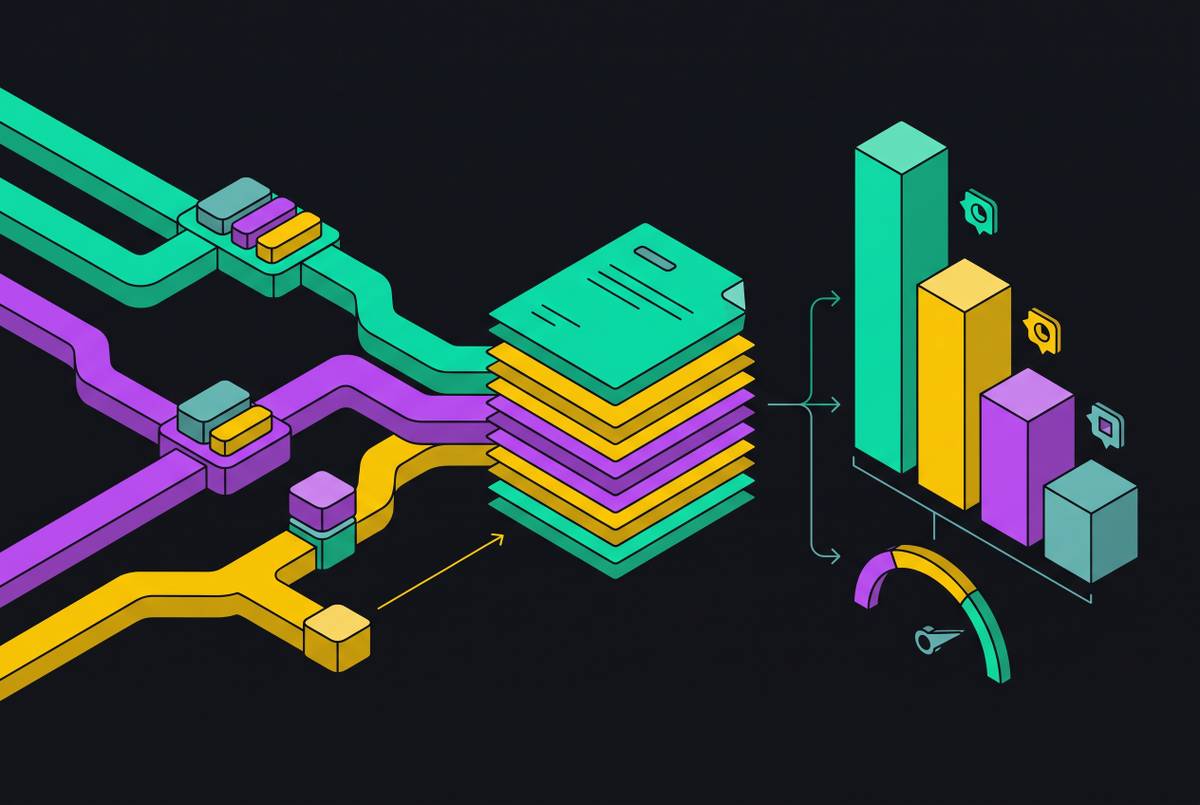
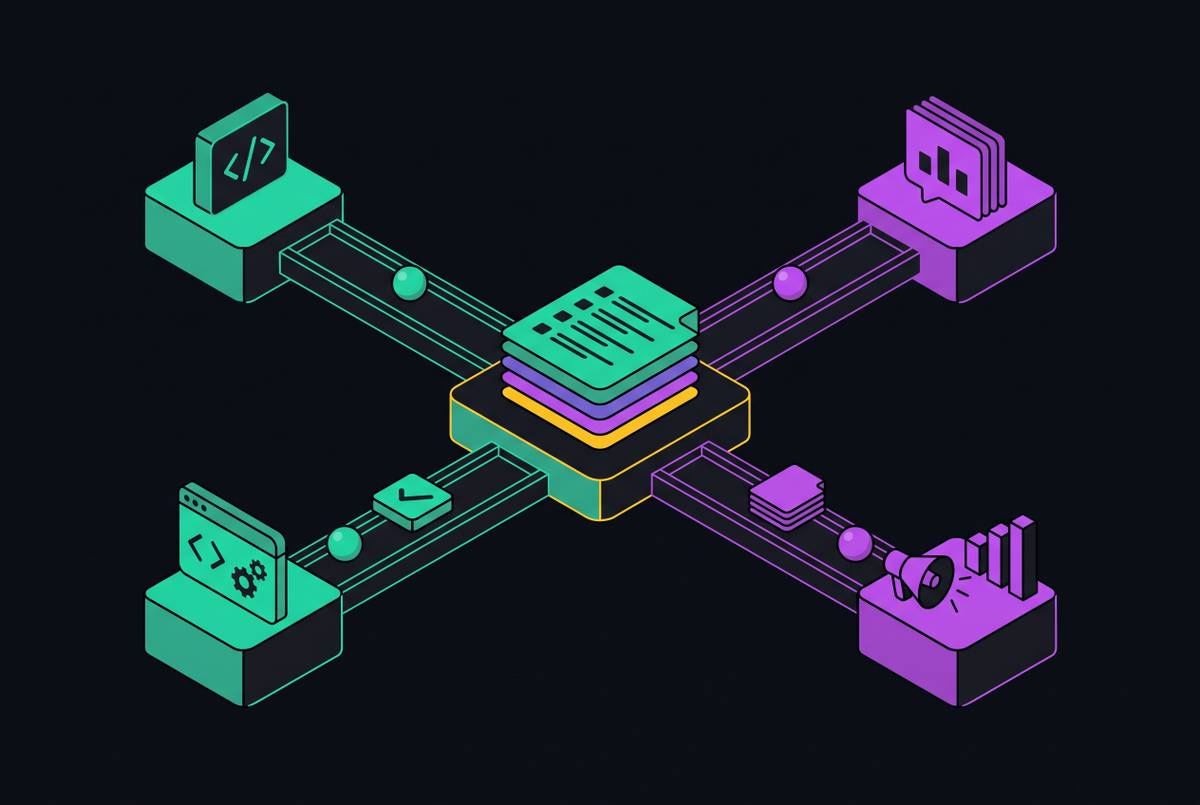
Change detection is what turns a merge into a publishing trigger. Tools like Bump.sh already handle automatic spec diffing and changelog generation, so the time between a merged PR and a visible, readable diff shrinks close to zero. From that diff, a four-stage content process picks up the work. AI-driven generation treats the diff itself as the brief: the endpoint name, the schema change, the deprecation flag, and any prose already present in the spec feed directly into a draft, with no separate briefing document needed. A review step follows, where a human or an automated check sees the draft inside a pull request before it goes live, though in Autopilot configurations that review gate is skipped entirely and the draft publishes on its own. Once approved, the post gets pushed to its destination through the CMS's own API. From there, the same pipeline fans out to a changelog page, a developer newsletter, or a documentation site, all from the single diff that started the process.
Klaviyo's move in September 2026 to open its platform to external AI agents, exposing more than 260 MCP tools and more than 490 APIs through third-party interfaces, shows where the integration layer that enables this kind of pipeline is heading. Platform APIs are becoming directly queryable by AI writing agents, which cuts down the custom integration work a spec-to-content pipeline used to require just to read a spec and act on it.
Three cases from real API ecosystems where the pipeline is absent
When no one converts a spec change into clear developer content, the cost isn't a missed marketing moment. Developers are left without the information they need to keep an integration from breaking, and someone else ends up telling the story the API owner didn't.
Meta announced on October 8, 2025, the deprecation of its legacy Advantage Shopping Campaigns and Advantage App Campaign APIs, laying out a phased migration plan that ran through the release of Marketing API version 25.0 on February 18, 2026. A migration roundup covering that deprecation ended up written by someone outside Meta, because Meta's own changelog entries were scattered across version pages, blog posts, and out-of-cycle notices, with no single narrative tying the pieces together for a developer managing a live integration through that window. The migration guide that developers needed got written, just not by the company best positioned to write it first.
LinkedIn's August 2026 release, version 202608, carried several changes that each demanded a developer response: the Matched Audiences API became generally available, a cap on DMP segments per ad account went into effect (with a 429 error returned to accounts that exceeded it), account-level dynamic UTM support arrived, and new Marketing and Sales Qualified Lead conversion types were added. Each change meant a decision for the teams relying on the API: auditing segment inventories against the new cap, updating version headers, deciding whether account-level UTMs fit existing tracking governance. The official changelog entry described what changed without narrating what a developer had to do about it. A practitioner-level breakdown published on dmarketertayeeb.com filled that gap, reframing the changelog as a checklist of decisions teams needed to make before the August 31 deadline, which is close to the kind of content LinkedIn's own developer marketing could have published first.
Set against those two, HubSpot's handling of a similar situation shows what capturing the moment looks like. Rather than let a versioning policy sit as a dry governance notice, HubSpot's Spring 2026 Spotlight told that same policy as an agent-compatibility benefit, giving developers a reason to see the change as useful rather than as paperwork.
How changelogs compound in value as a publishing channel
Publishing a spec change isn't only a defensive move against broken integrations. Run consistently, it builds an asset that keeps paying out. A changelog that publishes dated, illustrated, plain-language entries on a steady cadence ranks for the long-tail, product-feature searches developers actually run, and gets picked up by technical press along the way. A year of entries at three per week typically brings in 1,000 to 10,000 monthly organic visits if the writing holds up, and Linear's changelog is treated as a model for this pattern through 2025 and 2026, publishing new entries roughly two to four times a month.
Every entry works on its own as a discrete, searchable asset. A migration guide surfaces in search results exactly when a developer is debugging the integration it covers. A deprecation notice ranks for the name of the old endpoint, catching the developer still searching under the name they know. A new-endpoint announcement answers "does this API support X" before the question gets asked on a support ticket. None of these need to be found through a homepage or a product tour. Each stands on its own, discoverable on its own terms.
The compounding effect comes from structure, not volume for its own sake. Every merged spec change that turns into a published post adds one more page that can rank, get cited, and be linked to, without any added editorial effort once the pipeline is running. That matters more as AI answer engines become a front door to developer discovery in their own right. Being cited inside an AI-generated answer depends on having published content that's specific and attributable, and a changelog entry naming an endpoint, a version number, and a date is exactly the kind of structured claim an answer engine can point to.
Why automated spec content goes generic
The strongest objection to an automated spec-to-content pipeline is that the output reads like every other AI-generated changelog post: flat, interchangeable, forgettable. The failure sits in the instructions given to the model. AI given generic instructions produces generic output, and developer content has its own version of that problem. Left unconstrained, a model defaults to corporate filler: "leverage," "utilize," "comprehensive," "in the realm of," words that appear constantly in training data and carry almost no information in a technical changelog entry describing what an endpoint now does.
The fix sits upstream of publishing, before a draft exists. Giving a model three to five defined voice traits, each paired with its opposite, along with concrete do's and don'ts and a list of banned phrases, gives it something specific enough to work against. That specificity is what produces a draft that reads like the team itself wrote it, rather than like a template filled in with that week's endpoint name.
The human review gate that most teams rely on doesn't hold under pressure. The usual workflow has a person check the AI draft before it publishes, and under deadline pressure that check gets skipped constantly, with "close enough" going live instead. A pipeline that enforces voice at the point of generation relies less on an unreliable review step. HubSpot's framing of its versioning policy as an agent-compatibility benefit, mentioned above, shows voice constraint working at the framing stage: the same underlying governance fact, told as something useful to a developer instead of as a policy notice to comply with.
Building the pipeline: the build-versus-buy decision for lean teams
Everything above points toward a practical choice facing lean developer-marketing teams that ship continuously but have no real editorial bandwidth to spare. The average GTM organization had accumulated dozens of tools by 2026, many overlapping and few of them actually talking to each other, and the broader trend is collapsing that sprawl into a smaller stack where the core logic lives inside infrastructure the team already owns. For a spec-monitoring pipeline, the build-versus-buy decision comes down to one trade-off: a pipeline built in-house gives a team more control over scoring logic and voice constraints, but it needs engineering time that small teams rarely have free; an integrated platform absorbs the monitoring, scoring, drafting, and publishing into one system, turning the work mostly into configuration rather than custom engineering.
Whichever path a team takes, the minimum viable pipeline needs four pieces in place. It needs a spec watcher that detects diffs at the endpoint or field level: a semantic diff that shows what actually moved inside the schema, not just a notice that a file changed. It needs a scoring layer that filters out noise, like dependency bumps and typo fixes, and flags the changes that actually affect a developer's integration. It needs a drafting layer that takes the structured diff as its brief, applies the voice constraints described above, and produces a finished post rather than a template with blanks filled in. And it needs a publishing integration that pushes the result to the changelog, the documentation site, or the newsletter without anyone manually copying text between systems.
Teams that treat this as an engineering discipline, instrumenting the pipeline, measuring what gets published against what gets skipped, and iterating on the scoring logic over time, get more out of it than teams that set it up once and leave it alone. Signal-driven publishing platforms built for developer-tool and API-first teams, the kind that monitor merged pull requests, releases, API specs, and regulatory updates, and score changes against a team's positioning before drafting anything, are the integrated version of this same stack, built for teams that ship constantly but can't staff a traditional editorial function. An editorial calendar was always a workaround for not having a system. A spec-to-content pipeline, built or bought, is the system itself.
Sources
- Recent Marketing API Changes - LinkedIn
- Meta deprecates legacy campaign APIs for Advantage+ structure
- HubSpot just fixed one of its most frustrating developer problems
- Changelog
- If your AI content feels generic, this is why
- How to Turn Your Changelog Into a Growth Channel
- How to Automate API Changelog Generation - Doc Holiday
- Documenting API Changes - by Bruno Pedro