Autopilot Publishing Pipelines for Continuous Shippers
Automated pipelines turn continuous shipping signals into a ranked content queue.
If a product ships on a schedule slow enough to plan around, an editorial calendar can work. Continuous shipping breaks that assumption: when engineering pushes a release every two weeks, the product marketer is still drafting launch material for feature A while features B and C have already gone into production. This piece is about what replaces the calendar when that happens: a pipeline that treats every meaningful product signal, a merged pull request, a spec change, a release tag, as the trigger that starts the content cycle on its own.
Why the editorial calendar fails teams that ship continuously
A product marketer who worked from a calendar built a content plan around a launch. That model fit a world where releases were events: a team spent months building toward a date, and the content, sales enablement, and messaging all pointed at that date like spokes on a wheel. Continuous shipping removes the wheel's center. There's no single date to build toward because there are new dates constantly, each one smaller than the last, each one arriving before the previous one has been written up.
A permanent lag opens up between what the product does and what the record of the product says it does. A team that ships every two weeks accumulates a backlog of unannounced, undocumented, uncelebrated changes faster than any single writer can turn them into posts. The editorial calendar didn't cause this lag. It was a workaround for a deeper absence: no system was watching the work as it happened, so someone had to plan content in advance and hope the plan held. A faster planner isn't the fix; a pipeline that watches the work directly and starts the content cycle the moment something worth writing about actually happens is.
What A Product Signal Is
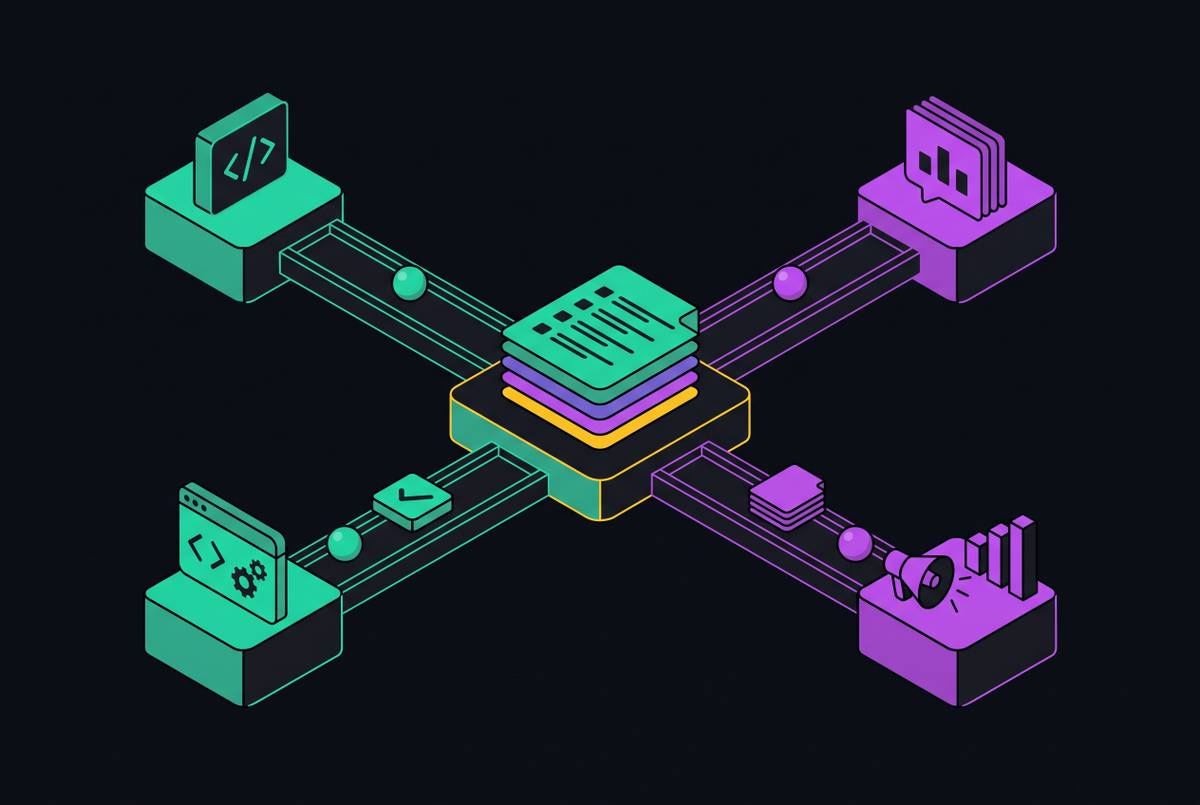
A signal, in this architecture, is any event in a product's engineering or business record that could plausibly change what gets said publicly about that product. Several concrete types belong in that category. A merged pull request is the base case: it's the canonical record that something actually shipped, as opposed to something that was merely planned. A release or version tag marks the moment a change becomes available to real users, which is a meaningfully different moment than the one where code merged into main. An API spec change, an addition, a deprecation, a breaking change in a published interface, is a signal with direct downstream consequences for anyone integrating against that product. Regulatory or industry updates count too: a rule change that alters what a product must do, or how it should be positioned, is exactly the kind of event a content pipeline exists to catch. Internal documentation changes, in a wiki or similar tool, often mark a shift in how a team understands its own feature or position, and that shift is worth tracking. Industry news, a competitor's move, an ecosystem shift, an emerging standard, rounds out the list.
Not every event in that stream deserves a post. A dependency bump, a typo fix, a CI configuration tweak: none of these carry a story a product's audience would care about. The engineering record already has everything a content pipeline needs, but most of what passes through it is just operational housekeeping, not material for publication. Conventional commit conventions offer a first useful filter here, because they're machine-readable before any human judgment gets involved. A commit tagged feat: is a candidate worth evaluating further. A commit tagged chore: or docs: usually isn't, and a breaking change, under the conventional commit spec, is marked by a dedicated footer token or a "!" appended to the type, not by its own commit type. That distinction matters for any pipeline trying to parse commit history automatically: breaking changes need to be caught by that footer convention specifically, not inferred from a type prefix that was never meant to carry that weight. None of this filtering, on its own, tells a team what to publish. It tells the pipeline what's even eligible to be scored. That's where the real decision happens.
Scoring: Turning Events Into a Ranked Content Queue
Filtering by commit type narrows the stream. Scoring is what makes the narrowed stream safe to automate against. Without scoring, an autopilot pipeline just produces volume, a flood of technically accurate but strategically worthless posts about every feat: commit that cleared the first filter. With scoring, the same pipeline produces relevance, because every surviving event has been evaluated for whether it's actually worth a human's attention.
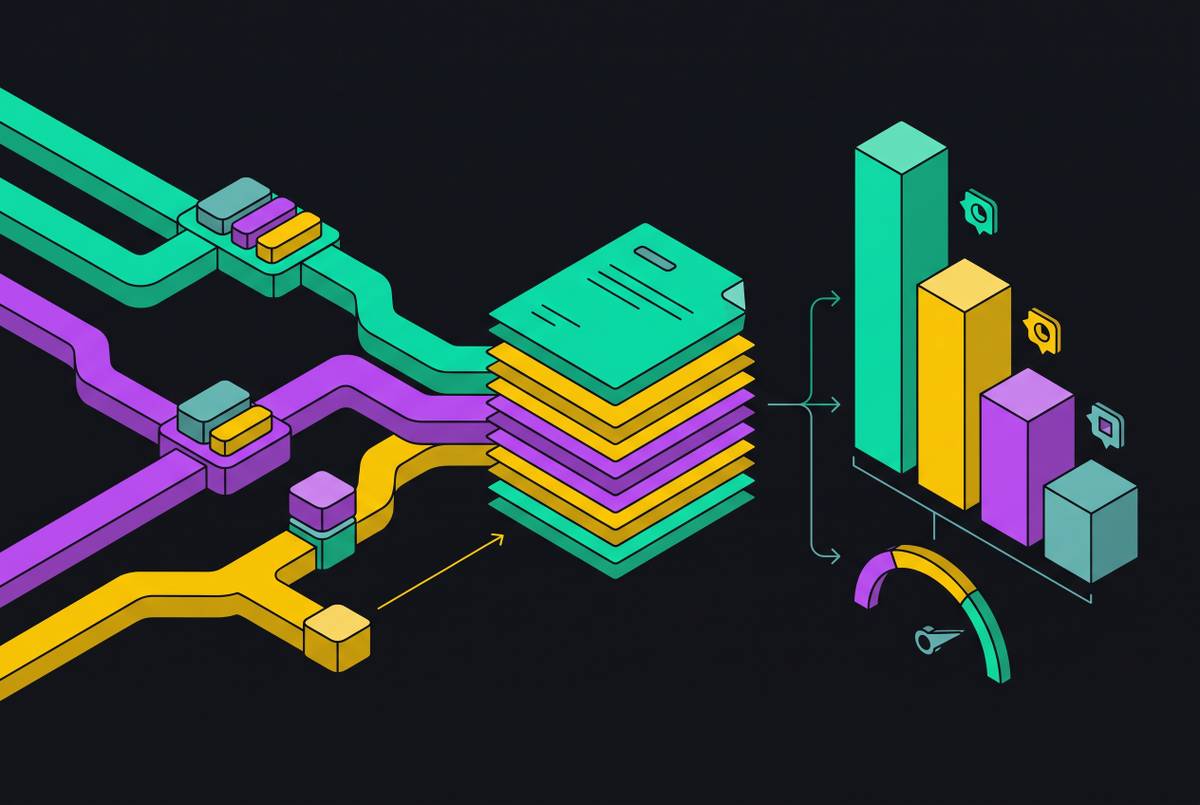
A scoring system in this architecture evaluates each incoming event against at least three axes. Positioning fit asks whether the change advances, reinforces, or complicates the product's stated differentiation, the thing the product claims to be better at than its alternatives. Audience impact asks whether the change touches something a target user actually cares about: a workflow, an integration, a pricing model, a compliance posture. Timeliness asks whether some external event, a spec change in a dependency, a competitor's move, a regulatory deadline, makes this particular signal more urgent to publish now rather than in three weeks.
An event that scores below a threshold never enters the content queue. A human never sees the dependency bump, because it never earned a score high enough to surface, which protects a team's time from noise. Events that clear the threshold enter a ranked queue, and the pipeline attaches a suggested format to each one, a changelog entry, a technical post, a migration guide, an announcement, based on the type and size of the change behind it.
The scoring model itself isn't fixed. As a product's positioning shifts, the model needs to shift with it: a feature that scored as noise six months ago can become a headline today simply because the market around it moved. The same logic applies to signals that originate outside the repo. If a regulatory update touches a product's actual compliance surface, it scores high. A regulatory update in some adjacent industry, one that doesn't touch the product directly, scores low and gets dismissed the same way a chore: commit does.
So for a team shipping continuously, the queue is never empty, and it's never overwhelming either, because the scoring step has already done the triage a human editorial director would otherwise spend hours doing by hand. That queue, properly maintained, is what replaces the editorial calendar. The queue is the structure that makes the calendar's planning function unnecessary in the first place, not a supplement run alongside it.
The path from scored signal to published post: what each stage of the pipeline does
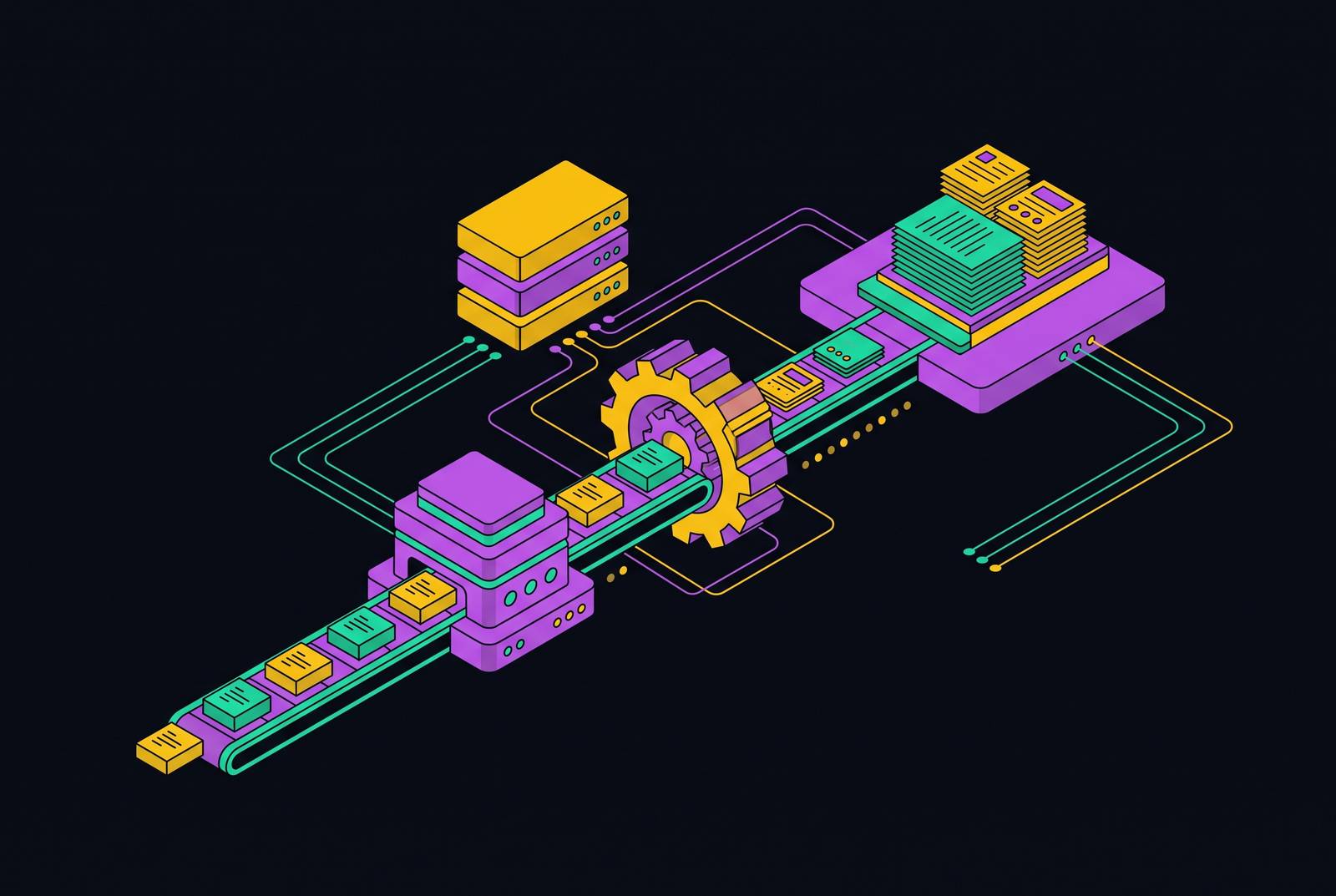
A scored signal sitting in a queue is still just data. Turning it into a published post requires a sequence of stages, each one deterministic enough to run without a human handoff in between.
The first real stage is briefing. A templated brief, generated automatically from the research a signal carries with it, usually takes an hour of manual work and compresses it into a two-minute review. Of every stage in the pipeline, briefing automation saves the most effort for the least quality risk, because you can template a brief reliably, but it still gets a human glance before anything downstream builds on it.
From the brief, drafting runs against a persistent brand voice layer: tone, vocabulary, a list of banned phrases, and a set of reference examples that keep the output grounded in this specific change rather than in a generic prompt that could describe any product's feature update. Here a team makes a real design choice between two modes: one that holds every draft for review, and one that publishes automatically. In suggest mode, a human decides on every draft before it moves further down the pipeline. Autopilot mode lets high-confidence, low-risk content types, a changelog entry drafted from a tagged release, for instance, move straight to publish without that checkpoint. Which mode applies to which content type is a judgment call a team has to make deliberately.
Publishing and formatting are the stages that automate best of all, because they're pure mechanics: converting a draft into the right markup, attaching the right metadata, scheduling the right send time. There's no editorial judgment required at this stage, and humans tend to do it inconsistently when they do it by hand.
Distribution happens on publish. The pipeline fires downstream to a CMS push, a search engine notification through IndexNow, social channel copy written for each platform's format, a newsletter queue entry, and an internal Slack announcement, each channel getting copy suited to its own format rather than a copy-paste of the post body. IndexNow specifically notifies participating search engines, Bing and Yandex among them, though not Google, the moment new content goes live, which speeds up discovery for announcements where timing matters.
The Changelog as the Highest-Leverage Publishing Surface
Every stage described above points toward one output format better than any other: the changelog. Structurally, a changelog entry takes a scored signal and renders it directly into user-facing prose. It explains what changed, why the change matters to the person reading it, and where to go next. That's the exact shape of output the pipeline is built to produce, which makes the changelog the format where signal-triggered publishing looks least like automation and most like ordinary, well-run product communication.
A workable model for changelog publishing has three layers that serve three audiences from one source. A technical changelog lives in the repo, for developers reading diffs. A public changelog lives on the product's site, so users can evaluate whether to adopt or upgrade. A changelog newsletter serves users who want the digest version rather than the running feed. All three draw from the same underlying material, so you don't need a third drafting effort to serve a third audience.
The automated version of this process filters feat: and fix: commits at each release event, a tag, a merge to main, and uses the conventional commit messages as raw material. From there, the pipeline drafts user-facing rewrites, converting developer-oriented commit language into plain-language, user-impact framing, and a batch review approves what gets published. A changelog entry that explains why a change was made gives developers context they can actually use. A release note describing a breaking change, linked to a migration guide and paired with a before/after example, earns goodwill with the people who'd otherwise be filing support tickets about it.
Linear's changelog, hosted at linear.app/changelog, illustrates what this looks like sustained over time: dated entries, several per month, written in plain language. One entry from May 2021, covering a preview of Linear's roadmap timeline feature, ranks first for the search term "linear timeline," years after it was published. Supabase runs a different but related model, Launch Week, a week of daily announcements with press outreach organized weeks in advance. The format has caught on so widely that a community-run site, launchweek.dev, had documented 126 such launch weeks across 94 companies as of 2024. Neither example is the pipeline itself. Both show the same underlying principle holding at scale: a changelog maintained consistently compounds. It builds a searchable, linkable record of a product's progress that accumulates search traffic, surfaces in AI answer engines, and signals active development to anyone evaluating the product, none of which a single quarterly launch post can achieve no matter how well it's written.
Extending the Pipeline Beyond the Repo
Everything described so far watches a team's own engineering record. The same architecture extends outward, watching the technical and regulatory environment the product operates in, and for API-first products, that outward-facing monitoring matters as much as tracking a team's own releases.
Several categories of external signal carry direct content value. A deprecation or version change in a shared dependency's API spec should trigger a migration guide or compatibility post before users run into the breaking change themselves, not after. A competitor shipping a new API version is an opportunity for a comparison or positioning post while the news is still fresh enough to matter. A regulatory update that touches a product's actual compliance surface should trigger an explainer that positions the team as informed and prepared, rather than reactive. An industry event, a standards body publishing a new spec, a major provider changing a pricing model, should trigger a "what this means for you" post that answers the question an audience is already asking.
The architectural principle carries over from the internal case without modification: continuous watching replaces periodic manual scanning, and scoring against positioning filters out the external noise the same way it filters out a chore: commit. Signal APIs make this practical, because they let a pipeline get alerted the moment something shifts in the watched environment, rather than requiring someone to check a page on a schedule and hope they didn't miss the week it mattered. The internal signal taxonomy described earlier was only half the system. The regulatory and spec-change half is what most teams underbuild, and building it turns a release-notes generator into something closer to a market-awareness engine.
Where Autopilot Pipelines Break Down
None of this is an argument that automation is risk-free. The real failure mode isn't automation itself. It runs without persistent brand context, without structured inputs, and without a quality gate before anything goes live.
Generic AI output is usually described as a model quality problem, but it's more accurately a pipeline input problem. A system that starts every drafting session from a blank page, no brand voice layer, no reference examples, no scored brief behind it, produces content that could belong to any company in any industry. That's a failure of what gets fed into the system, dressed up as a failure of the system itself.
A practical gate against this is what might be called the Competitor Swap Test: if a published post could run unchanged on a competitor's site and nobody would notice, the brand voice layer isn't doing its job. If you run this check before approving any automated output, you catch the generic-content failure before it reaches a reader, not after.
Two stages in this pipeline resist full automation for good reason: editing and fact-checking. These are the stages where automated content fails in public, a wrong number, a mischaracterized feature, a claim that doesn't hold up, and they're also the stages where a human reviewer adds the most value per minute spent. The design boundary that follows from this is straightforward to state: automate confidently up through a first draft, and never let autopilot mode carry a post past that point without a human review pass for its factual claims. So a pipeline built on that boundary gets the speed continuous shipping demands, without inheriting the credibility risk that unreviewed automation would otherwise carry into every post it touches.