Comparing Draft.dev to Boutique Technical Writing Services
Draft.dev scales content production; boutique services embed in your product workflow.
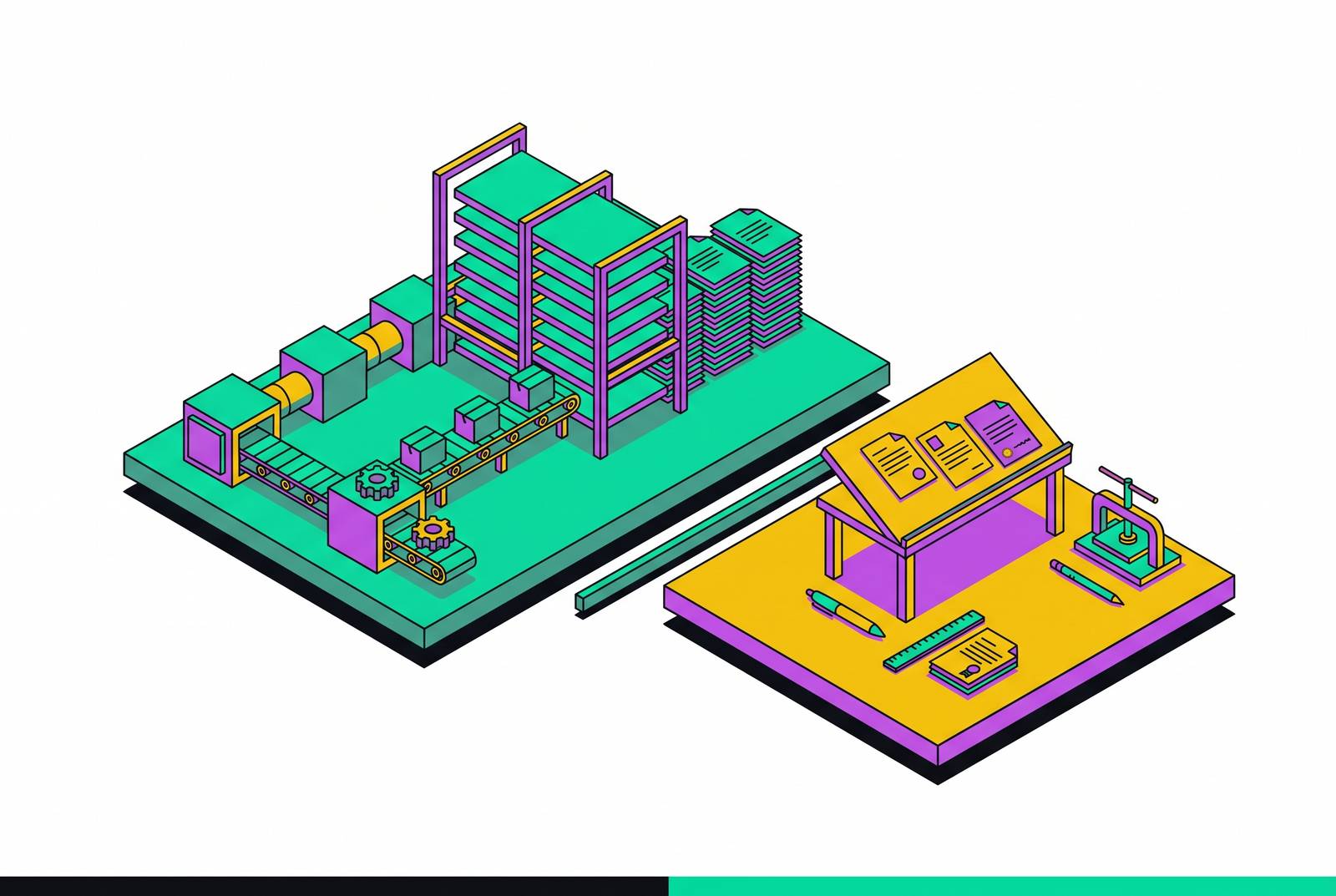
Draft.dev is built for throughput and to cover a wide range of technical topics, while boutique services work with more product context and fit into the client’s workflow. The right choice depends less on which model produces “better writing” than on whether a team needs more production capacity, closer coordination with engineering, or a shorter path from product change to publication.
How the technical content agency market split into two distinct models
The technical content agency market has divided around two assumptions about what clients need. The throughput model assumes a team has a defined content goal and needs a vetted production operation to execute it across many technologies. Its organizing concern is capacity. Writers and editors provide the coverage that an internal team cannot produce on its own, while the client supplies enough direction to keep that work aligned.
The embedded model starts from a different constraint. The embedded model assumes that a brief cannot hold all the knowledge or set up all the coordination that content needs. A partner therefore works inside the client’s tools and publishing cadence, operating more like a fractional internal function than an external supplier. These models may produce similar-looking articles, but the work behind them differs. One organizes production around a content program, while the other connects production to the changing state of a product.
What Draft.dev actually is and what it is built to do
Karl Hughes founded Draft.dev in 2020 after working as a CTO, addressing a gap between marketing and engineering. Marketing teams lacked the technical depth to write convincingly for developers, while engineering teams were not in the content business. Draft.dev was built to bridge that gap. It is a technical content marketing operation designed to build and run programs at scale, rather than a general writing shop that occasionally covers developer topics.
Its results show what that model can accomplish. Hughes’s 2025 client roundup reported strong click-through rates for Sinch Mailgun’s developer content and a substantial increase in Earthly’s monthly blog visitors. Vcluster scaled its Kubernetes blog fourfold, while Status Hero increased blog traffic and trial conversions. The 2025 Inc. Regionals: Midwest fastest-growing companies list also recognized Draft.dev. Those facts establish a record of growth and client outcomes, without making every outcome transferable to every buyer.
Hughes also wrote about where the model ran into trouble. Draft.dev maintained strong cashflow through Q1, while leading indicators showed declining deal closures heading into Q3 and Q4. Those results put pressure on a static definition of scale, because teams that produce a serviceable draft quickly and iterate can compete with teams that deliver a polished piece slowly. Production capacity and responsiveness are separate capabilities.
The model consequently works from an important assumption. The client has enough strategic clarity to tell the production operation what it should accomplish. Draft.dev can execute a substantial program, but capacity alone cannot settle an unresolved question about what a team should say. For a buyer in 2026, the diagnostic question is whether the content problem is insufficient production volume or insufficient iteration speed.
What boutique technical writing services are structured to do differently
Boutique technical writing services organize their work around closer involvement in the client’s process. An embedded service takes charge of the work from product context to publication, rather than splitting a large publishing program among a wide network of writers. A small supplier that receives briefs and returns documents does not automatically offer the integration that defines this model.
In a repo-native engagement, that integration is concrete. Writers write in Markdown, work in Git, review through pull requests, and run the CI/CD pipeline that publishes documentation with code releases. Content review then participates in the workflow used to change the product, rather than arriving through a separate document handoff. That structure is particularly relevant when documentation must stay synchronized with implementation.
Boutique expertise can also take a strategic form. EveryDeveloper, run by Adam Duvander, focuses on developer experience strategy and content as a solo consultancy, with pricing through consultation. Duvander previously worked as a developer marketer at Zapier and developer communications director at SendGrid. Its value proposition is depth of developer experience expertise. This illustrates why “boutique” describes a different allocation of expertise.
A service that handles one request at a time cannot produce as much at once as a large agency. In exchange, it can compete on responsiveness, integration, and the fit between content and product. Its usefulness therefore depends on whether close involvement removes more friction than additional writers would remove. For some teams, the scarce resource is context.
Why the throughput model fits some teams and fails others
The throughput model fits when strategy is clear, the target developer is defined, and production capacity is the missing element. Building topical authority over 18 to 24 months requires sustained coverage. A boutique handling one request at a time cannot cover the same topic surface at the pace available to a larger operation.
That advantage becomes useful under recognizable conditions. Competitors may already be writing about the problems a product solves while the team has little content of its own. Engineers may also spend too much time rewriting drafts from writers who do not understand the implementation. In that situation, engineering-credible production can address a real bottleneck. The goal is to cover more of those topics without making engineers do most of the writing for the marketing program.
Hughes wrote that when the team was unsure what clients wanted, the high-volume model could slip into order-taking and leave the team spinning. The production engine needs a brief to work against. If the client cannot say who an assignment is for, what it should cover, or what it should achieve, sending more assignments leaves those questions open in each one.
A team shipping features weekly can find a six-to-eight-week production pipeline misaligned with the moment each feature deserves a published story. The delay between a change becoming useful and content making that change visible creates the mismatch. When that delay is the binding constraint, iteration speed becomes more valuable than parallel production.
Where repo-native and changelog-driven content demands a different operating model
Changelogs, release notes, API change announcements, and spec-linked documentation depend on what has actually shipped. They cannot function reliably as reflections of an editorial plan alone. Their source of truth is the product. Teams that ship all the time need repository access to do this work, beyond any preference they have for familiar tools. The content process must pick up changes close to where they happen so it can describe the current implementation.
Changelog culture also serves a different objective from broad search coverage. A changelog email puts a new feature directly in front of users, who are more likely to try it than users left to discover it organically. That makes the changelog an adoption channel. Treating it as a housekeeping document overlooks the connection between announcing a change and helping existing users act on it. Publication timing is part of its usefulness.
Docs-as-code supplies the workflow for that connection. Markdown authoring, Git version control, pull-request review, and CI/CD deployment let documentation move through an engineering process. Redocly and Mintlify support this approach natively. Stainless uses GitHub Actions installed in a repository to respond to OpenAPI spec changes and trigger downstream SDK updates. Its mechanism is an action or CI trigger, rather than an independent monitoring service.
A monthly editorial calendar does not provide that coupling. An embedded boutique sees API changes and spec updates while working inside engineering, but a volume agency needs set ways to get the same signals. The distinction is not that an agency can never adapt. It is that a calendar-based engagement does not supply repository integration by itself, and a buyer cannot assume one will follow from the other.
Automated, signal-driven publishing works in much the same way. Platforms in this category can monitor merged pull requests, releases, API specs, and regulatory updates, then score changes against a team’s positioning before drafting. For lean teams, that offers a route toward integration and consistent throughput without a full agency retainer, particularly when finding the publishable signal is itself a substantial part of the work.
How each model handles the generic-AI content problem, and why it matters more now
Technical correctness is not sufficient to distinguish content in 2026. A piece can be defensible in every detail yet sound interchangeable with content from every other tool in its category. This is a central risk of generic AI-assisted production. More output does not help a product become recognizable if the output strips away its technical decisions, particular use cases, and constraints.
The embedded model has a structural advantage against that problem. A specialist working closely with a product accumulates context that extends beyond a style guide. Specific knowledge gives the writing its texture. It provides reasons to describe one implementation choice or explain a constraint.
That advantage comes with a concentration risk. If the boutique depends on one writer, a departure or capacity crunch can disrupt the voice of the whole program. The volume model’s editorial layer provides redundancy. Its strength on this dimension is not necessarily deeper product familiarity in each contributor, but a process that is less dependent on one person remaining available.
Brand-voice training is now a baseline for a serious AI writing workflow. A style guide can describe tone, but accumulated product context supplies the decisions, examples, and limitations that make the tone credible. Brand voice is a pipeline problem because the route from product knowledge to published text determines which distinguishing details survive.
The fit conditions that actually determine which model a team should choose
The decision rests on four variables, namely strategic clarity, shipping cadence, dependence on the codebase, and internal capacity to manage an external operation. None is a proxy for writing quality. The practical choice is to select the model that addresses the current constraint, rather than buying maximum capacity or maximum involvement in isolation.
A throughput agency fits when the strategy and target developer are clearly defined and stable. The need should be topical coverage built over months, with search authority and lead generation as primary measures of success. Engineering review bandwidth must also exist. More drafts create more review cycles, even when the writers are technically capable. This model is appropriate when the team can brief and manage production but cannot supply enough of it internally.
A boutique or embedded service fits when content must reflect the product as it exists this week. Changelog culture, docs-as-code, and API-change storytelling call for repository access and participation in engineering workflows. Context also becomes especially valuable when voice differentiation is a strategic priority. For a lean team, an embedded partner can absorb coordination that would otherwise fall on staff briefing and managing an external production operation. The corresponding limit is lower parallel output, particularly in a one-request-at-a-time engagement.
A signal-driven platform is a legitimate third option when detection and publishing latency are the primary constraints. It is relevant to engineering-led teams shipping faster than an editorial workflow can track, where continuously identifying changes and producing positioned drafts can be more useful than commissioning assignments. A team choosing among these options is ultimately choosing what initiates its content process, whether a stable brief, an embedded partner’s product context, or a detected change.