Using Automated Pull Request Summaries to Onboard New Engineers
Automated summaries turn merged code into searchable records of architectural decisions.
Automated pull request summaries can turn merged code into a navigable record of engineering decisions. Their onboarding value depends on preserving motivation, architectural reasoning, and team conventions alongside descriptions of a diff. Building that record requires a pipeline that captures good inputs, generates context-rich summaries, and makes the archive retrievable.
Why the merged PR is the richest onboarding document a team never publishes
A new engineer arrives at a codebase and finds the result of decisions without a map of how they were made. The modules show what the team chose. They rarely show which alternative was rejected or which constraint forced the design. READMEs and onboarding documents provide a necessary snapshot, but the history of pull requests records the motion that produced it.
The merged PR connects the change to its motivation and the reviewers who challenged it. That combination makes it an unusually rich onboarding artifact, because the discussion exposes reasoning that the implementation cannot express. At the pace teams merge code, a newcomer cannot read every diff and discussion to reconstruct the system. The failure lies in how the available documentation is organized.
What gets lost when a PR closes without a summary
A review thread may contain the rejected alternative, the performance benchmark that tipped the choice, or the security concern that constrained it. None necessarily survives in the code itself. A new engineer can understand what a module does while remaining unable to explain why its boundaries were drawn that way. Architectural reasoning is particularly difficult to reconstruct once the conversation has receded into the archive.
Review comments also contain an implicit style guide. Naming patterns, the abstractions the team prefers, and objections that come up again and again show standards that formal guidance may leave out. When the engineers who remember those exchanges leave or move teams, the code still runs, so the loss of that knowledge stays hidden. Discussions scattered across tabs, comment threads, and dashboards make recovery harder for newcomers who do not know where to look. If the knowledge remains in the PR, what would make it retrievable?
How automated PR summarization turns the archive into navigable memory
Automated summarization extracts and structures information already present in a PR, leaving missing explanations unfilled. A summary generated at merge time captures that context before the author moves on and reviewers forget the discussion. Natural-language descriptions let a newcomer skim why a change was made before deciding whether to look at how it was built. The summary becomes a navigation layer over the diff.
Its usefulness depends on the context available to the summarizer. A tool that sees only changed files cannot fully explain how a change in Module A affects Module B’s behavior. Whole-repository awareness helps newcomers reason across modules so they can understand architectural decisions. Structured summaries also give an AI assistant a more useful corpus to retrieve from when an engineer asks about an earlier decision. That second use depends on the same specificity that makes the archive readable.
The tools that generate PR summaries and what each one contributes to onboarding
Greptile builds a graph of the entire repository, including every function, class, and dependency, before reviewing a PR. Specialized agents check security, logic, and how a change affects other files. This gives its analysis a system-level foundation. For onboarding, that context can explain how a local change propagates from the edited file across modules.
CodeRabbit provides detailed natural-language summaries and can generate sequence diagrams for changes involving component interactions, including API calls, event flows, and async workflows. The diagrams make changes with many interactions easier to understand. It integrates with GitHub, GitLab, Azure DevOps, Bitbucket Cloud, and Bitbucket Data Center, making toolchain fit another consideration beyond its presentation features.
Graphite Agent provides an interactive companion on the PR page, with explanations of complex logic, diff-level feedback and fixes, and conversational follow-ups. Its stacked PR workflow structures work into small, atomic changes. Those smaller units support more focused summaries. A newcomer can follow the construction of a feature in small increments, avoiding the work of untangling one large merge.
GitKraken provides a Code Review workspace that presents relocated code as moved rather than deleted and re-added, while downplaying formatting churn. That filtering helps newcomers distinguish intent from mechanical edits. AI-assisted summaries and review signals surface context inside the PR, while Launchpad aggregates PRs and issues across repositories into a unified orientation point.
GitHub Copilot Code Review generates PR summaries and inline comments within GitHub across Pro, Business, and Enterprise tiers. Its integration with VS Code and GitHub Enterprise Cloud avoids an additional tool for teams already using that stack. Depth remains a consideration for architectural onboarding. Lower effort analysis tends to focus on style and obvious bugs, while higher effort levels, now the default, find logic and security issues but are still weaker at spotting architectural concerns.
Qodo uses specialized agents and custom rules tied to engineering standards to review code with those rules and its context in mind. Reading the resulting feedback shows a new engineer which conventions the team has formalized, rather than requiring those conventions to be inferred from scattered comments.
GitHub Releases generates release notes from merged PRs on demand through the release interface or an API/CLI flag. It does not automatically trigger when a tag is cut. Its output is less narrative than dedicated tools. However, it offers a lightweight chronological index without an external SaaS dependency.
Release Drafter automatically drafts release notes as PRs merge through an open-source GitHub Action. It fits lean or open-source teams that want a free, version-controlled pipeline without external SaaS. Codebase-context depth, existing tools, team size, and governance requirements determine the fit, while release-note tools can extend the same record into a public changelog.
What makes a PR summary actually useful for onboarding versus useful for review
A reviewer needs to decide whether a change is safe to merge. A newcomer needs to understand why it exists. Summaries organized around diff scope, risk flags, and test coverage answer the first question, but motivation, rejected alternatives, and demonstrated conventions answer the second.
The distinction is concrete in a retry-handler change. Saying that it now uses exponential backoff describes the implementation. Adding that it replaced fixed intervals after the November outage exposed their failure under sustained load explains the decision. That motivation usually lives in the description, linked issue, or review thread. Automation cannot recover reasoning that nobody recorded, and a newcomer cannot reliably distinguish thin source material from a poor summary. Improving the output therefore begins with improving the input.
The input discipline that determines whether summaries carry real context
A PR description template requiring motivation, an alternative considered, and the constraint that ruled it out provides a practical starting point. Defining those fields is a one-time investment that supplies useful material on every future merge. Linking the originating issue adds a statement of what went wrong for users. Together, those inputs let the summary trace the path from symptom to diagnosis to solution without inventing the missing steps.
Commit conventions strengthen that record at a finer grain. Atomic, intentional messages provide a narrative that “fix stuff” cannot. Contribution guidelines and review expectations make this discipline explicit, so automation supplements human communication. The template establishes what engineers need to explain before the summarizer runs. Even with that material, though, the output must use the team’s own language to teach its conventions.
Why generic summary prose undermines the onboarding goal and how to prevent it
An accurate but generic summary can explain a decision while obscuring how the team thinks about it. A newcomer learns vocabulary as well as architecture. When a summary uses broad technical language in place of the team’s module names and domain terms, it loses the cues that tie it to code and review discussions. Neutral instructions encourage neutral output, even when the underlying PR is specific.
The remedy is to give the summarizer the team’s architectural vocabulary, naming patterns, PR template fields, and examples of strong descriptions. Explicit exclusions also protect the voice. Rules against words such as “leverage”, “robust”, and “seamless” remove generic phrasing more directly than an instruction to sound professional. When the same summary supports a public changelog, that precision also provides a sound basis for explaining the release externally.
How the summarized PR archive becomes a queryable knowledge base for new hires
A structured archive changes onboarding from linear reading into active querying. A newcomer can ask why the retry logic changed in Q2 rather than guessing which commits contain the answer. Whether the interface is search or an AI assistant, retrieval depends on the underlying record naming the relevant module, tradeoff, and outcome. Vague summaries give the retrieval process little to distinguish.
The useful workflow moves from a question to a decision summary and then to the underlying PR when more detail is needed. The engineer no longer has to begin with excavation. As the archive grows, related summaries expose how an architectural choice evolved into its current form. This is a property of the source material on which an assistant depends. Distributed teams gain from the same structure when engineers need to understand decisions made in another timezone.
Setting up the summarization pipeline — what to configure before the first PR merges
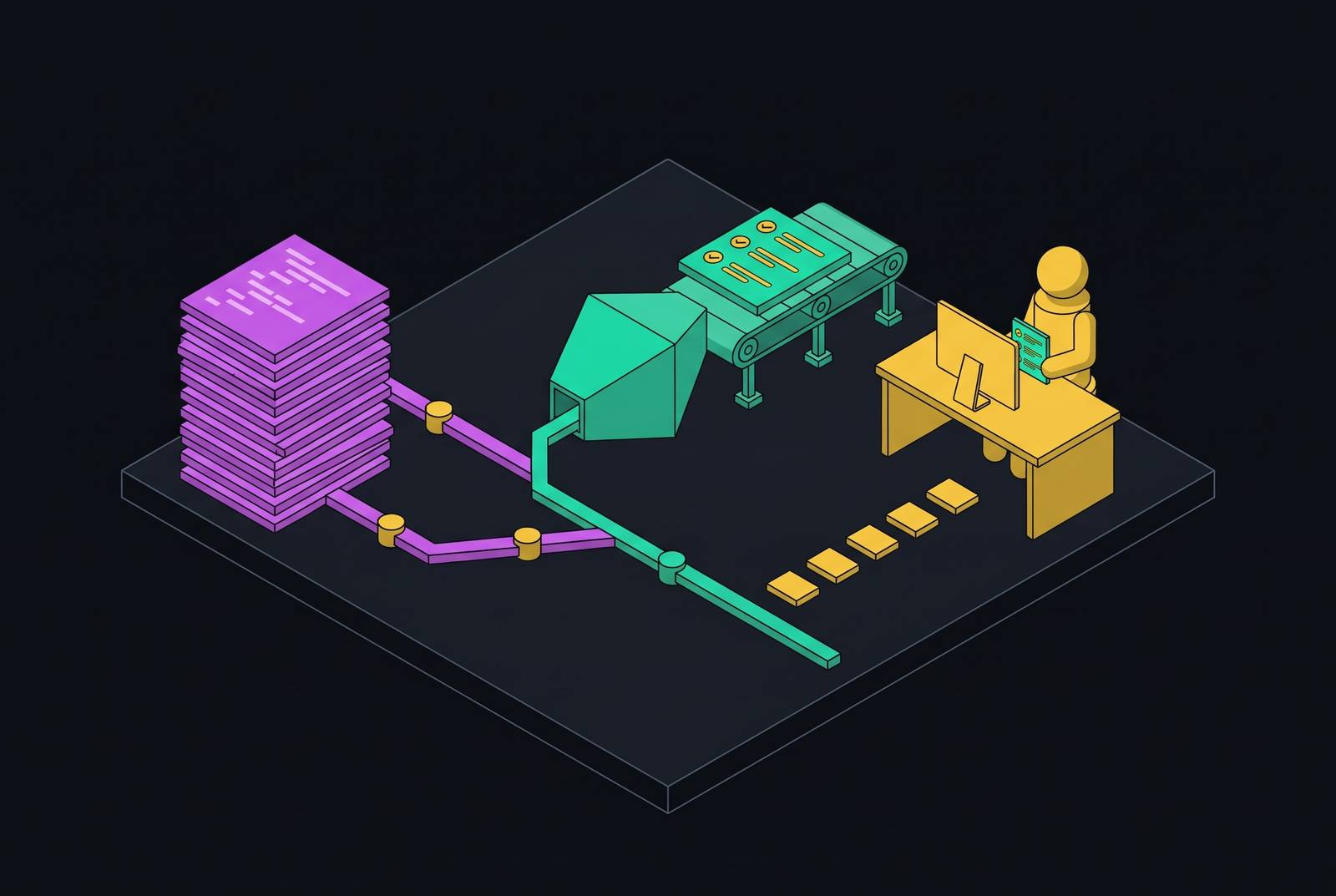
For a team implementing this approach, configuration proceeds through input, summarization, and retrieval. At the input layer, define the template fields for motivation, alternatives, and constraints, then establish commit-message conventions. Link PRs to the issue tracker so the originating problem is available to the summarizer. This layer supplies the reasoning that code alone cannot.
At the summarization layer, choose the context depth the codebase requires, from diff-only analysis to a whole-repository graph. Give the tool the team’s architectural vocabulary, naming conventions, and rules for what to leave out. Decide which changes need a summary before drafting begins. Scoring or labeling PRs by significance prevents dependency bumps, typo fixes, and formatting-only changes from diluting the archive. A dedicated tool can add repository context, visualization, or stacked-PR support where a native foundation is insufficient.
At the retrieval layer, decide whether summaries belong in PR comments, a wiki, a changelog, or all three. Keep the storage format sufficiently machine-readable for future querying. For teams that publish release notes for developers, the public changelog is another place to share the same record of decisions. That extension should preserve the specificity that made the internal summary useful.
How teams that treat PR summaries as infrastructure change what onboarding produces
Keeping a summarization pipeline running adds to what the team remembers with each merge. The first newcomer may inherit a thin archive, while later hires gain a denser record of architectural decisions, conventions, and lessons. Its usefulness extends beyond the first weeks of employment. A senior engineer returning from leave, a team inheriting a legacy service, or someone investigating behavior introduced months earlier can recover the same context without depending entirely on another person’s memory.
For lean teams, automation also narrows the gap between shipping speed and documentation speed. The record grows through the development workflow, avoiding a separate effort to reconstruct history. Public release narratives can use that work, but it helps the engineering team most. Better descriptions produce better summaries, and those summaries demonstrate to newcomers what a useful PR description contains. As those engineers begin contributing, their descriptions improve the material available to the next round of summaries.