DX Engineer Role Definition and Responsibilities
How DX Engineers cut developer friction from pipelines to AI.
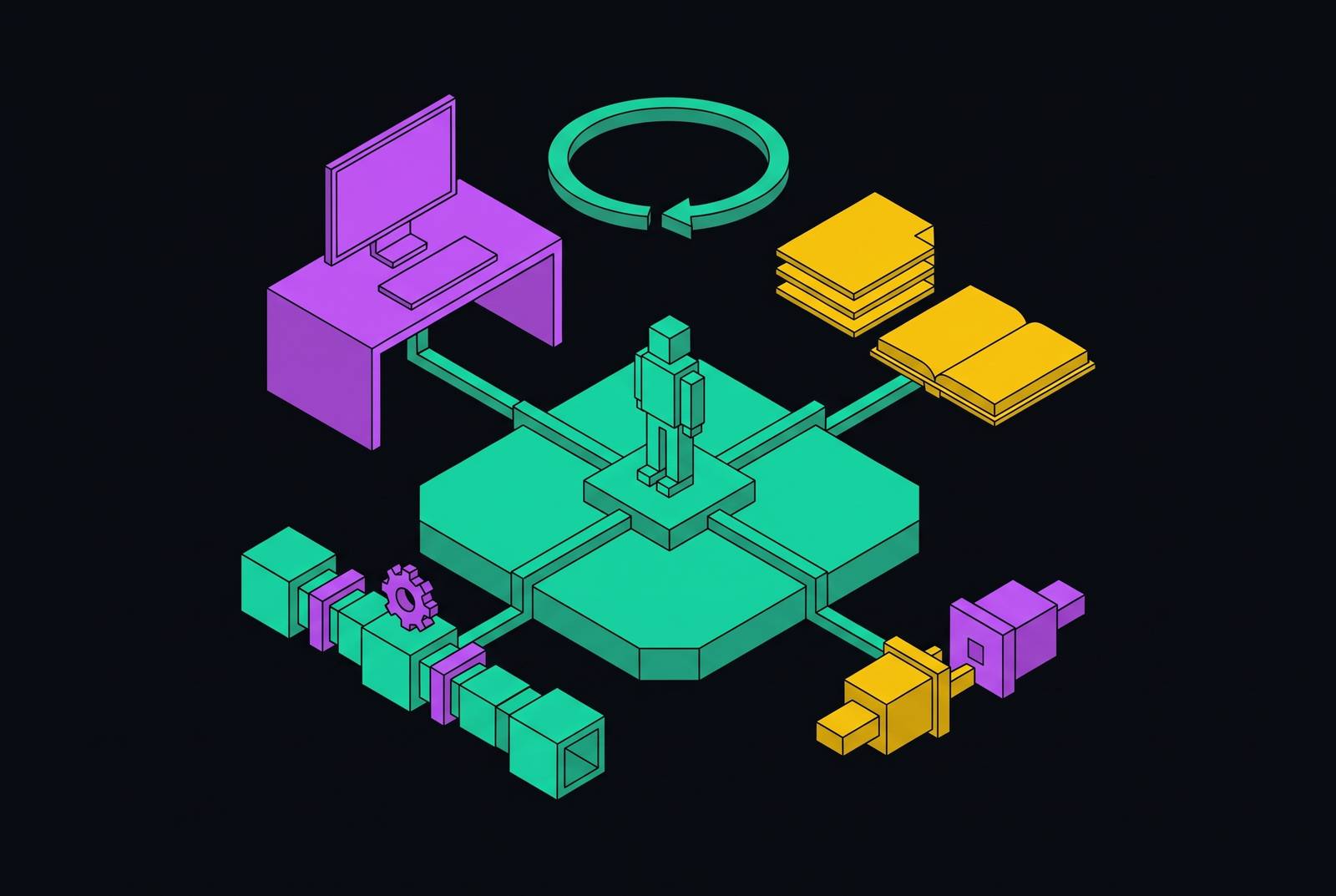
The DX Engineer role is defined by reducing friction across the development lifecycle. Its responsibilities span delivery pipelines, environments, documentation, platforms, and AI systems because each can either interrupt developers or help them ship. The role succeeds when those systems free product engineers to focus on business logic.
What the DX Engineer role is and what problem it was created to solve
Modern software organizations depend on cloud infrastructure, microservices, CI/CD pipelines, and observability systems that can become fragmented. Product engineers then spend time intended for building the product on navigating the delivery system. Fragmentation becomes a tax on engineering attention. The DX Engineer exists to create and maintain an ecosystem that reduces this cost throughout development, improving both productivity and developer satisfaction.
Unlike traditional DevOps, which emphasizes operations and infrastructure, DX Engineering takes a product management approach to internal tooling, aiming for self-service platforms that abstract infrastructure complexity. A functioning system is necessary, but developers must also be able to use it without repeatedly seeking help or reconstructing how it works.
Vercel's careers page describes the role as sitting “at the intersection of engineering, education, and AI.” That combination explains why the position includes building tools, designing systems, and helping developers understand them. These serve a common customer, the engineer trying to make progress.
The core responsibilities that follow from reducing friction
CI/CD pipeline design follows directly from the cost of waiting for, interpreting, and recovering from delivery failures. The DX Engineer owns pipelines that are fast, reliable, and easy to debug when they fail. This is a shared point of leverage. Because product engineers repeatedly pass through the delivery pipeline, improving it reclaims time across the organization.
Development environment tooling standardizes local setups, often through containers or cloud development environments, so onboarding and context-switching do not require repeated configuration work. Testing infrastructure builds on that foundation with environments and frameworks that engineers can rely on. Engineers can then practice good testing without first building its scaffolding.
Infrastructure provisioning creates another recurring source of unnecessary decisions. Internal Developer Platforms, or IDPs, provide self-service APIs for infrastructure, databases, and environments, placing Kubernetes, Terraform, and cloud networking behind simpler commands. Product engineers no longer have to manage raw manifests. Observability helps in much the same way during debugging, with logging, metrics, and tracing that developers can make sense of without knowing the infrastructure in depth.
Documentation and developer portals complete this ownership surface by making the system understandable. Up-to-date documentation and internal wikis reduce the cost of decisions that would otherwise require another engineer's explanation. Across these domains, the question remains where engineers lose time or make decisions that a shared system could remove.
Why platform engineering — not individual heroics — is how DX scales
The “everyone owns infrastructure” model breaks down when cognitive overhead and inconsistent practices become a bottleneck. Asking each product engineer to understand the delivery stack distributes responsibility, but it also distributes complexity. Individual help cannot resolve that structural problem. When a DX Engineer keeps fixing the same obstacle for different people, every developer still has to go through that engineer for help.
Platform engineering changes that relationship by placing a self-service layer above the infrastructure. The IDP lets developers deploy and manage applications without first having to learn how the infrastructure works in depth. Its value comes from making common capabilities reusable. Tools are available to support this platform model, but the structural choice is more important than the particular tool.
An IDP brings together a service catalog with templates for common application patterns, deployment abstraction, and environment management. The shared foundation also includes secrets management, automatic monitoring integration, and built-in security compliance. These capabilities address more than the initial deployment. They let the platform handle infrastructure concerns that come up again and again, so each application team is spared the work of solving them on its own.
The resulting leverage comes from the abstraction. A simple deployment command can stand in for complex orchestration, while a common application template means engineers have fewer setup decisions to make each time. This is how the role multiplies capacity. Its output is a system that other engineers can use, rather than a queue of problems that only its builder can resolve.
How the DX Engineer thinks — the product manager mental model applied to internal tooling
Engineers describe their frustrations, the DX Engineer identifies where time is lost, and those findings become a prioritized build roadmap. The internal user supplies the starting point. Slow CI/CD, complicated environment setup, and unclear deployment processes are common findings because they recur across teams without always having an owner who has both access and authority to improve them.
The product manager mental model makes impact the basis for prioritization. Internal tooling is treated as a product whose users can explain where its design obstructs their work. Feedback is therefore part of engineering. A tool's technical completeness does not by itself establish that it has reduced the difficulty developers face.
This also explains why DX Engineering is not simply DevOps with a better interface. The outputs can look similar while the feedback loops differ. An operations-driven approach emphasizes reliability and DORA metrics, including deployment frequency, lead time, MTTR, and change failure rate. A user experience-driven approach evaluates developer velocity and cognitive load reduction. The distinction lies in what the team learns from developers and how that learning changes the next investment.
How the AI layer has expanded the DX Engineer's surface area
AI expands the role when it becomes a system to design and maintain. It requires the same product-thinking discipline as any other internal platform. Job postings from PlanetScale, Planet, and Atom Computing include the “AI Developer Experience Engineer” title in 2026. The expanded remit is visible in hiring. It places AI within the systems for which developer experience has explicit ownership.
That remit also reaches the way a company's content and documentation appear across AI platforms. Developers evaluating or adopting a product encounter those surfaces, so their experience is no longer confined to the company's own documentation portal. This adds a new observability concern. The DX mandate extends to understanding how those surfaces represent the product because they influence the developer's path toward using it.
If the DX Engineer must personally handle every new tool, documentation update, and release narrative, the role can become the bottleneck it was created to remove. The platform principle must apply inward as well. Automation offers a way to build capacity without making every additional responsibility depend on more manual work.
Signal-driven content pipelines are one expression of that approach. Systems that detect engineering signals and generate documentation, changelog entries, and release narratives at a regular cadence make publishing a repeatable process. This applies the same friction-reduction logic to the DX Engineer's own work that an IDP applies to product engineering.
Documentation and changelog ownership as a first-class DX responsibility
A stale or missing document can block progress just as a broken CI pipeline can. In either case, a developer needs help that the system should already provide. Documentation is therefore a platform surface. Its ownership extends the DX mandate beyond internal engineers to external developers evaluating an API or trying to use the product.
The changelog has a particular role in that evaluation. It shows whether the product is actively maintained, whether it appears safe to depend on, and whether its team is transparent about changes. A stale changelog can suggest that development has stopped.
Useful changelog entries preserve changes and explain why a decision was made so that future developers can understand it without finding someone who remembers the discussion. That makes the changelog part of the product's memory. Its value is not limited to announcing a release, because the explanation remains useful to internal and external developers afterward.
The DX Engineer's contribution is the publishing system. When an entry requires a context-switch, a blank document, and substantial rewriting of notes already in the repository, publishing becomes vulnerable to busy sprints. Signal-driven publishing instead picks out merged pull requests, releases, API spec changes, and other engineering events that could become content. A content automation platform illustrates this class of signal-watching infrastructure. Framed this way, content automation is an abstraction for documentation work, comparable in purpose to the abstractions used for deployment.
Where the DX Engineer role sits in the organization and who it serves
The DX Engineer works across teams, between developers and the people who help shape their working environment. Reporting lines do not alone explain that position. Its practical boundaries come from ownership of workflows, influence on architectural decisions, and responsibility for developer-facing information. The person in this role needs to be trusted as an engineer and able to communicate with people in non-engineering roles.
Product engineers are its primary internal customers. The goal is to reduce the infrastructure surface they must manage so that their attention remains on business logic. Platform and infrastructure teams provide the coordination needed to decide what gets abstracted. Developer relations and documentation teams share the surfaces that people outside the company use, while product management ties the priorities for internal tooling to the product roadmap.
Open-source teams and developer-tool startups that compete with well-funded commercial alternatives may put DevOps, platform engineering, technical writing, and sometimes developer marketing work in the hands of the DX role. That breadth can be a structural necessity. The same friction-reduction mandate applies whether the developer is an employee shipping a feature or an external user evaluating the API.
Cross-functional work depends on distinguishing what the DX Engineer owns from what must be coordinated with another team. Otherwise, everyone can face the same problem while no one is in charge of fixing it. The clearer the mandate, the more leverage the role can produce across those relationships.
How to evaluate whether a DX Engineer is succeeding
DX evaluation begins with whether product engineers spend more time on business logic and less on infrastructure. System uptime alone cannot answer that question. Useful leading indicators include platform adoption, time-to-first-commit for new engineers, CI/CD cycle time, environment-related support requests, and developer satisfaction gathered through regular internal feedback. Each reveals a different part of the experience rather than substituting one technical measure for the whole.
Platform adoption tells more when engineers have the choice to work around the IDP. Use suggests that the shared path serves their needs, while avoidance prompts closer examination of its friction. Documentation freshness provides another measurable surface. The delay between a feature shipping and its documentation appearing, together with questions that existing documentation should have answered, exposes gaps between product capability and developer understanding.
Attribution remains difficult even when those indicators improve. It is easier to demonstrate that a pipeline became faster than to prove that a DX investment caused a team to ship a feature it otherwise would not have shipped. Claims of impact need that distinction. Leading indicators and developer feedback are the most reliable proxies available.
The sharpest organizational signal is that product engineers stop thinking about infrastructure as a separate burden. The platform now handles the complexity that used to take up their attention. That outcome still requires continuing feedback, because measurement is an ongoing discipline. DX Engineering compounds when developers and the platform team keep that loop short, making improvement a property of the system.